LIN-01 is the baseline sleeve insert used to create a dry sliding surface inside a suitable housing. This page treats the membrane as a replaceable sliding interface rather than a complete bearing assembly. That distinction matters when the surrounding housing is already part of the customer design.
The catalogue gives the LIN material a density of 1.48 g/cm³. Dry sliding against steel is listed at a friction coefficient of 0.05–0.15, and the family maximum PV value is 0.4 N/mm²·m/s. Temperature guidance in the outline is -50 to +90 °C for continuous work and -50 to +120 °C for short exposure.
Design Highlights
✓LIN-01 is the baseline sleeve insert used to create a dry sliding surface inside a suitable housing.
↔Standard sliding-membrane series matched to the LIN-01 drawing
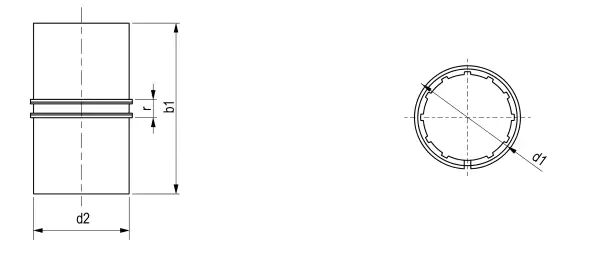
⚙Model identification uses: order code / d1 / tolerance / d2 / b1 / radius / weight
◆Catalogue pages 82–102 cover the LIN plastic family
Operating Envelope
Data boundary: The figures above are published family properties. Exact dimensions, housing fits and load values for LIN-01 stay model specific and should come from the selected catalogue row.
Where It Fits
Loose sliding membranes are useful when the machine builder already owns the outer housing design and wants the wear element to be the replaceable part. Food-packaging fixtures, light guides and wash-down mechanisms are typical places to evaluate this approach.
For LIN-01, corrosion resistance and lubricant-free travel can simplify machine housekeeping. The catalogue also notes that the LIN material can be cleaned with disinfecting solution, which is useful context for equipment where oil migration would be undesirable.
How to Select
For a membrane, measure the shaft and the receiving housing bore separately. The liner wall geometry and length are just as important as nominal shaft diameter, because the customer housing provides the external support.
After the geometry is identified, compare the real duty with the dry-running material limits. Record load, sliding speed, stroke, shaft finish and operating temperature in the RFQ so LIN-01 is checked as a system rather than as a bore-size lookup.
Fitting & Inspection
Press the membrane into a clean, correctly sized bore and use a chamfer that will not shave the polymer edge. After assembly, the shaft should move without a tight spot before the mechanism is loaded.
This family does not depend on scheduled grease replenishment. Inspection should instead look for abnormal clearance, embedded abrasive particles, heat and uneven wear; those symptoms often point to shaft or alignment issues around the LIN-01 installation.
Related Products
LIN sliding-membrane variants
LIN cylindrical plastic bearings
LIN flanged and LN pillow-block units
FAQ
What makes LIN-01 different from a ball-type linear bearing?
LIN-01 uses a dry polymer sliding interface. It does not use recirculating balls, so selection focuses on sliding pressure, velocity, temperature, shaft finish and the specific mounting geometry.
Is LIN-01 maintenance-free?
The supplied outline describes the LIN plastic family as maintenance-free and suitable for dry running; routine inspection is still needed for wear, debris and alignment.
What thermal limit should be used for LIN-01?
Use -50 to +90 °C as the published continuous range. The +120 °C figure is for short-duration exposure.
Which dimensions should be sent for a LIN-01 quote?
Send the shaft diameter plus the catalogue interface fields for this form: order code / d1 / tolerance / d2 / b1 / radius / weight. Include a drawing or photo when replacing an installed unit.
Request a Quote
Send the LIN-01 model if known, shaft size, quantity, mounting dimensions and duty conditions to sales@netherlandsdrive.com. Ever Power Netherlands Branch will use the supplied catalogue family as the technical reference for selection.