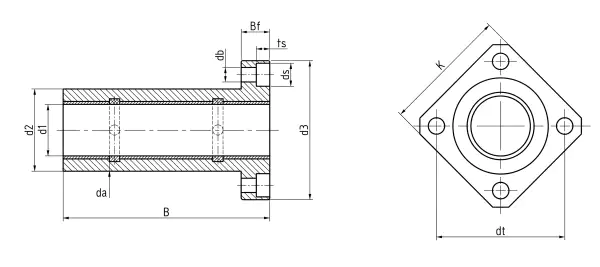
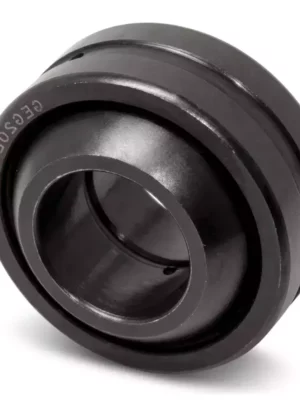
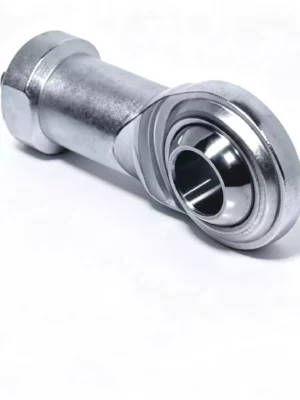
LIN-02RTL is the companion extended-flange configuration, with its mounting geometry taken from the dedicated catalogue drawing. This is the companion long-flange layout in the LIN-02 family. Its dedicated drawing controls the mounting interface; it should not be substituted solely by comparing overall length.
Even with the extended flange, the same dry-running polymer limits apply. Use 0.05–0.15 as the published dry friction band and 0.4 N/mm²·m/s as the family PV maximum. The source separates steady and short-term temperatures: -50…+90 °C continuous, with short excursions permitted to +120 °C.
Design Highlights
✓
LIN-02RTL is the companion extended-flange configuration, with its mounting geometry taken from the dedicated catalogue drawing.
↔
Alternate long flanged lin-02r family matched to the LIN-02RTL drawing
⚙
Model identification uses: order code / shaft d / body D / extended L / flange dimensions / bolt pattern / C / Co / weight
◆
Catalogue pages 82–102 cover the LIN plastic family
Technical Data
Data boundary: The figures above are published family properties. Exact dimensions, housing fits and load values for LIN-02RTL stay model specific and should come from the selected catalogue row.
Machine Integration
The alternate extended flange gives another mounting choice for machinery that needs a long polymer bearing station but follows the LIN-02RTL drawing rather than the RFL interface.
For LIN-02RTL, corrosion resistance and lubricant-free travel can simplify machine housekeeping. The catalogue also notes that the LIN material can be cleaned with disinfecting solution, which is useful context for equipment where oil migration would be undesirable.
Model Choice
Use the dedicated RTL drawing for bolt pattern, flange outline and long-body dimensions. Do not assume that an RFL mounting plate can accept RTL without checking every interface.
After the geometry is identified, compare the real duty with the dry-running material limits. Record load, sliding speed, stroke, shaft finish and operating temperature in the RFQ so LIN-02RTL is checked as a system rather than as a bore-size lookup.
Service Practice
Extended RTL units also need a straight shaft and flat flange datum. Check the far end of the long bearing for drag, which often reveals angular installation error.
This family does not depend on scheduled grease replenishment. Inspection should instead look for abnormal clearance, embedded abrasive particles, heat and uneven wear; those symptoms often point to shaft or alignment issues around the LIN-02RTL installation.
Related Products
LIN sliding-membrane variants
LIN cylindrical plastic bearings
LIN flanged and LN pillow-block units
FAQ
What makes LIN-02RTL different from a ball-type linear bearing?
LIN-02RTL uses a dry polymer sliding interface. It does not use recirculating balls, so selection focuses on sliding pressure, velocity, temperature, shaft finish and the specific mounting geometry.
Is LIN-02RTL maintenance-free?
The supplied outline describes the LIN plastic family as maintenance-free and suitable for dry running; routine inspection is still needed for wear, debris and alignment.
What thermal limit should be used for LIN-02RTL?
Use -50 to +90 °C as the published continuous range. The +120 °C figure is for short-duration exposure.
Which dimensions should be sent for a LIN-02RTL quote?
Send the shaft diameter plus the catalogue interface fields for this form: order code / shaft d / body D / extended L / flange dimensions / bolt pattern / C / Co / weight. Include a drawing or photo when replacing an installed unit.
Request a Quote
Send the LIN-02RTL model if known, shaft size, quantity, mounting dimensions and duty conditions to sales@netherlandsdrive.com. Ever Power Netherlands Branch will use the supplied catalogue family as the technical reference for selection.