Audible noise is evidence to investigate, but fault location depends on whether the sound tracks speed, torque or the machine structure.
Helical Gearbox Noise Diagnosis by Speed and Load
read more

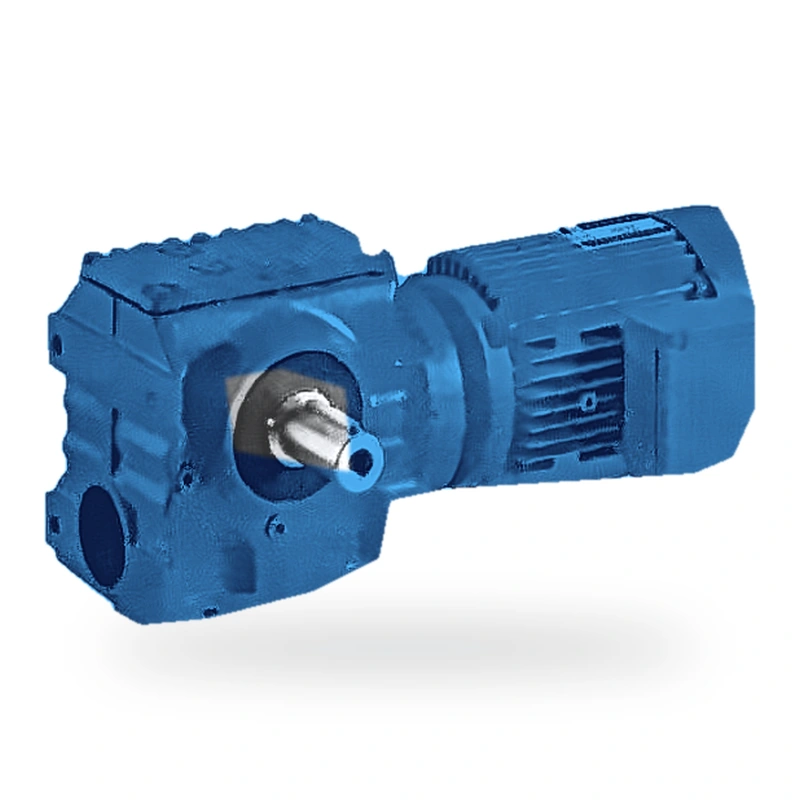
The EP-S47 is a 2 (1 helical + 1 worm) helical-worm gear reducer with right-angle output, delivering up to 270 N·m from 0.12–2.2 kW across gear ratios 8.74–196.11. Available in foot-mount (S), flange-mount (SF), hollow-bore (SA), flange+hollow (SAF), and torque-arm (SAT) configurations — quieter and more efficient than conventional worm reducers.
MOQ: flexible. Minimum order value USD 1,500; mixed orders and trial quantities welcome.
Food processing, pharmaceutical production, and precision packaging demand a right-angle gear reducer that maintains repeatable speed, tolerates frequent washdown, and generates minimal heat in production spaces where temperature control matters. The EP-S47 helical-worm gear reducer is engineered for exactly this environment — delivering up to 270 N·m output torque from 0.12–2.2 kW across ratios of 8.74–196.11, with an overall efficiency of 75–82% that significantly reduces heat output compared with conventional worm reducers.
The two-stage gear architecture — helical input, worm output — is optimally suited to duty cycles with moderate shock loading and frequent start-stop. The helical stage absorbs most of the speed reduction at high efficiency, leaving the worm stage to deliver the final ratio at low sliding velocity. This reduces the surface temperature of the worm gear set relative to a single-stage design, extending lubricant life and minimising the frequency of thermal-degradation-driven oil changes.
Stainless-steel fasteners, Viton lip seals, and NSF-approved food-grade synthetic lubricant are available as a washdown-service option pack. The smooth housing exterior has no unnecessary projections that trap contaminants, and the paint system is resistant to common cleaning agents. Our application engineers can advise on seal selection for pressurised or steam-clean environments.
| Parameter | Specification |
|---|---|
| Gear Type | Helical pre-stage + worm gear set (right-angle output) |
| Number of Stages | 2 (1 helical + 1 worm) |
| Motor Power Range | 0.12–2.2 kW |
| Max Output Torque | 270 N·m |
| Gear Ratio Range | 8.74–196.11 |
| Output Speed Range | 7–161 rpm |
| Approximate Unit Weight | 9–14 kg |
| Max Output Radial Load | 3,800 N |
| Overall Efficiency | 75–82% (vs 55–65% for equivalent single-stage worm) |
| Lubrication | Oil bath; ISO VG 220 synthetic-blend worm gear oil (factory fill) |
| Housing Material | Close-grained cast iron (HT250) |
| Worm Shaft Material | 20CrMnTi alloy steel, case-hardened HRC 58–62, profile ground Ra ≤ 0.4 µm |
| Worm Wheel Material | Centrifugally cast phosphor-bronze (ZCuSn10P1) |
| Helical Stage Material | 20CrMnTi alloy steel, case-hardened, precision ground DIN 6 |
| Protection Rating | IP55 standard; IP65 optional |
| Ambient Temperature | −25 °C to +40 °C (standard lubricant) |
| Noise Level | ≤ 68 dB(A) at rated load (1 m, free-field) |
| Standards Compliance | ISO 14521 worm gear rating; ISO 281 bearing life; CE Machinery Directive |
The S47 series is produced in five structural types plus an input-shaft-only SA-SZ variant. All share the same internal helical-worm gear train and achieve identical output torque and efficiency ratings. The structural type determines the mounting method and driven-machine interface.
| Type Code | Description |
|---|---|
| S47 | foot-mounted, solid output shaft |
| SF47 | B5 flange-mounted, solid output shaft |
| SA47 | shaft-mounted, hollow output bore |
| SAF47 | B5 flange + hollow output bore |
| SAT47 | torque-arm, hollow output bore |
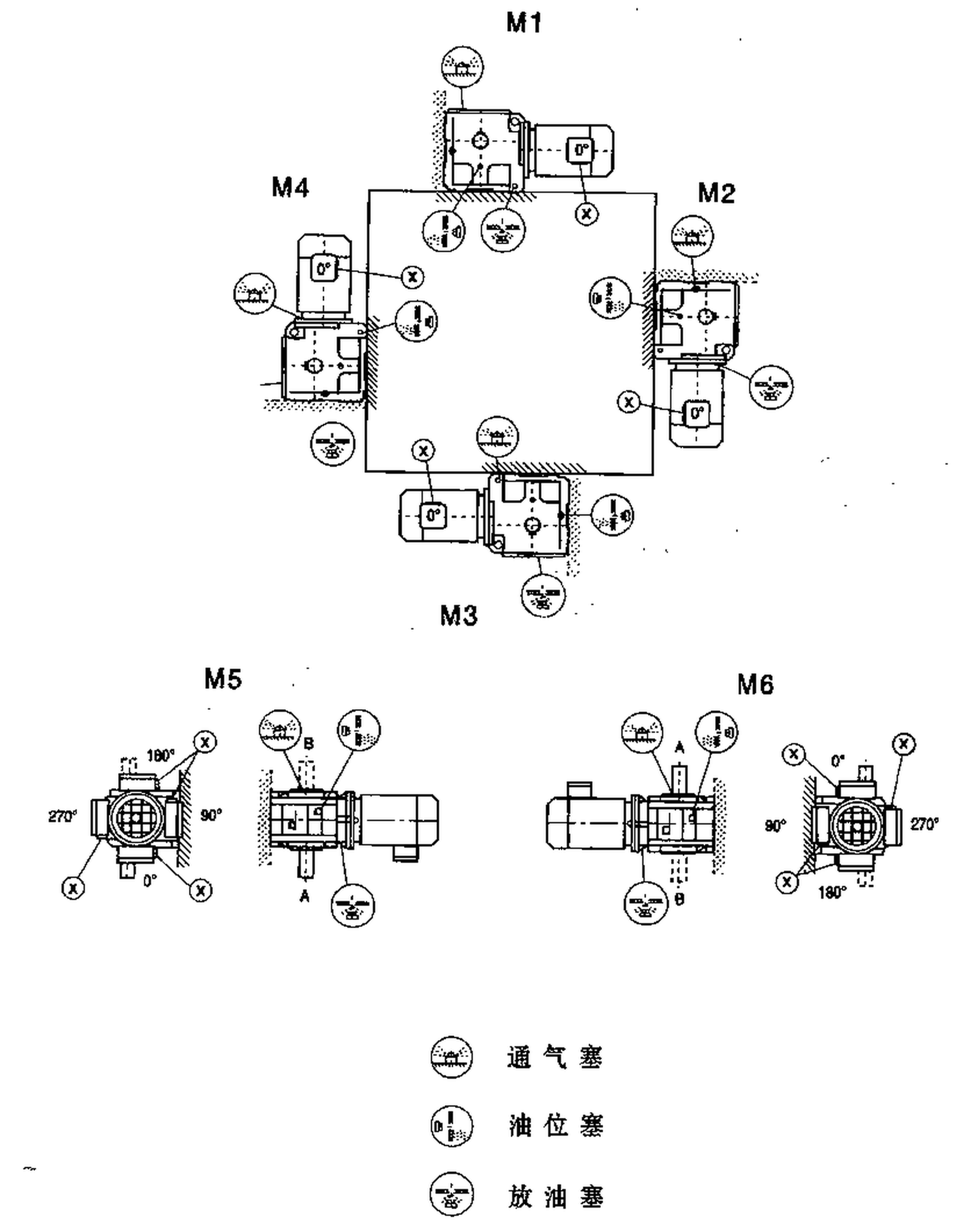
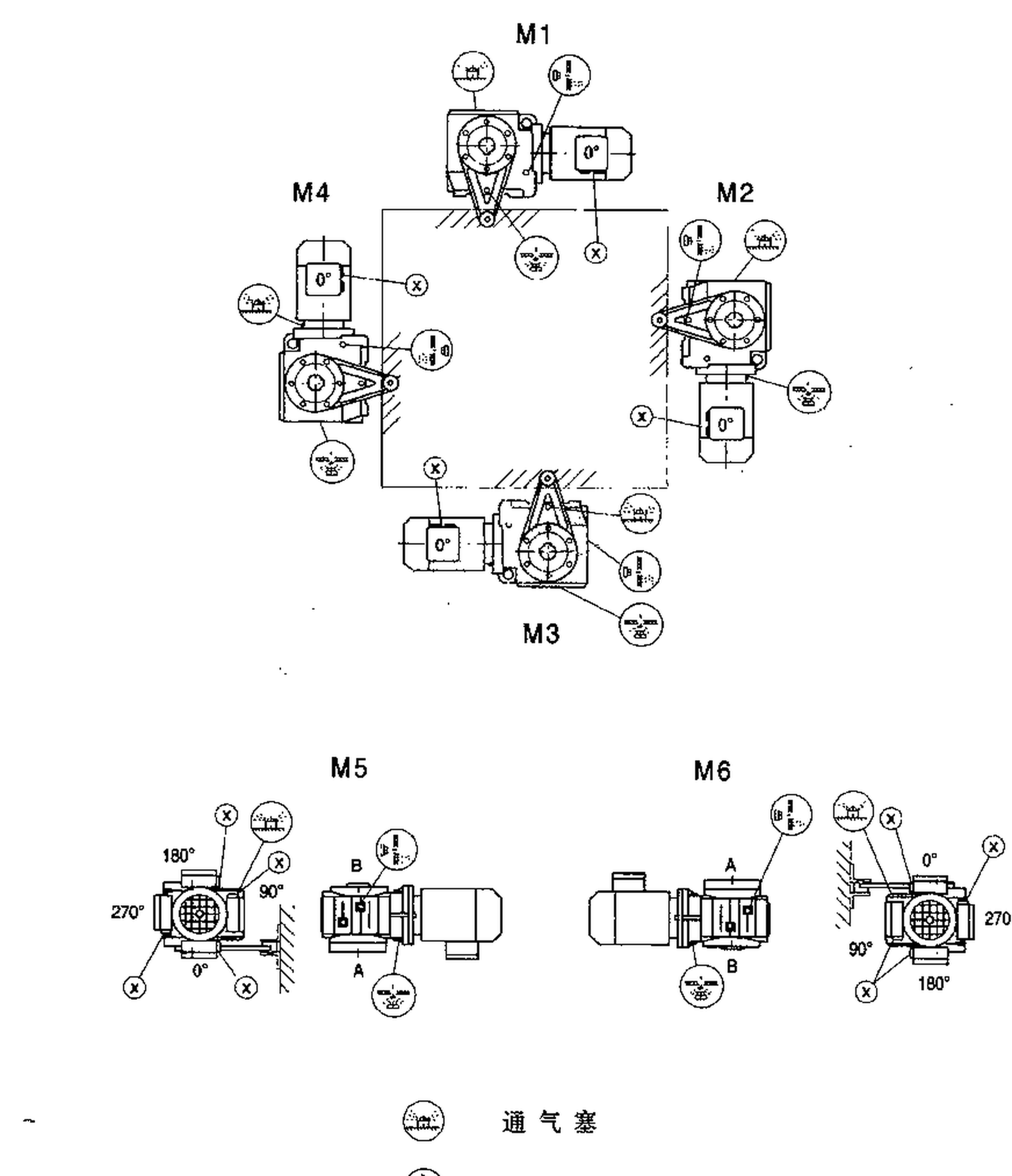
Flange-mounted SF47 and SAF47 variants support all six standard mounting positions. Oil fill level and breather plug position must be adjusted per mounting position — refer to the position-specific lubrication table in the installation manual.
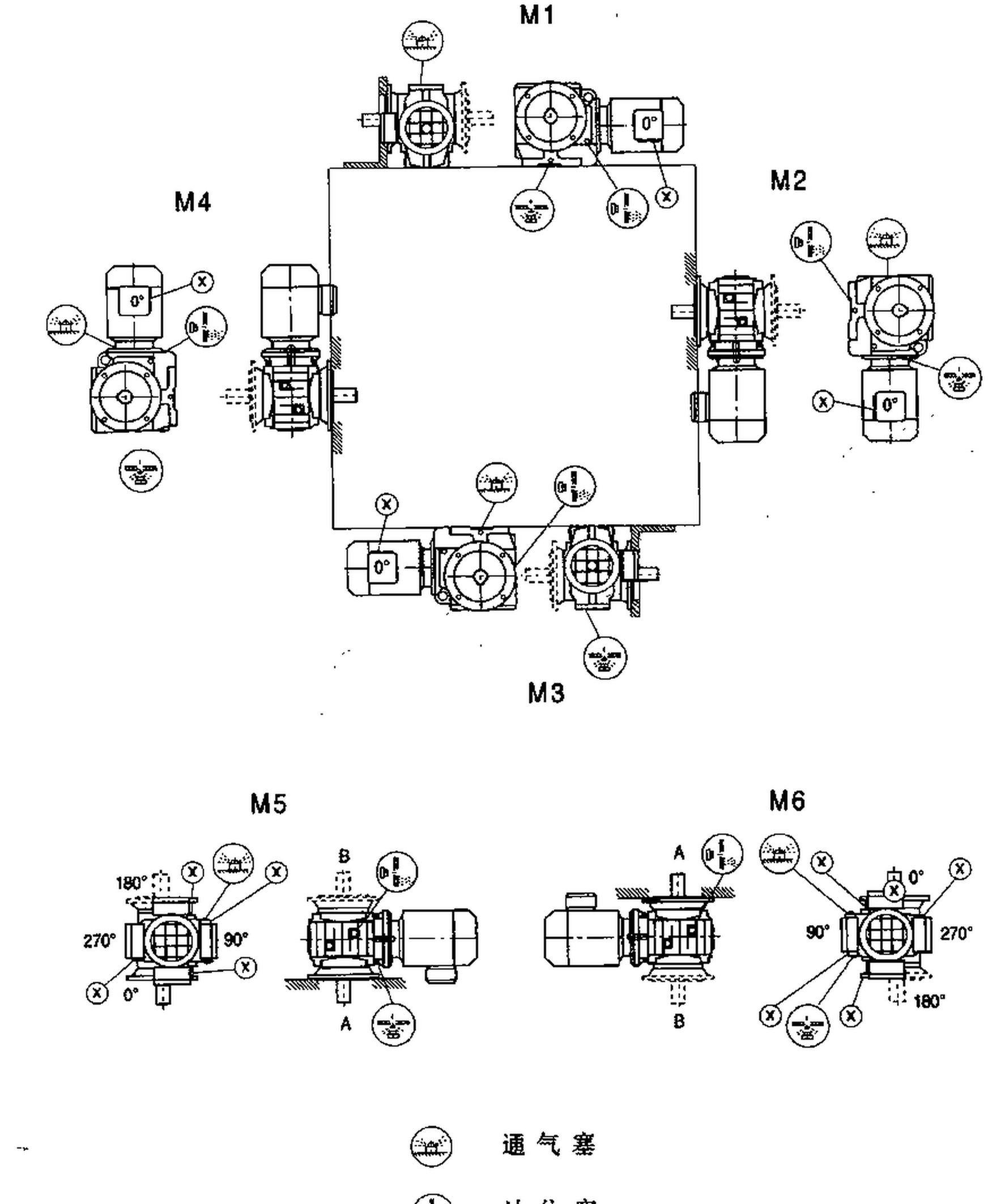
The SA47 shaft-mounted and SAT47 torque-arm variants mount directly onto the driven shaft, reacting torque through the torque arm rather than a baseplate. This eliminates shaft-to-shaft coupling alignment and is particularly suited to conveyor head drives and drum agitators.
The helical input stage of the EP-S47 achieves ≥98% per-stage efficiency, contributing directly to the 75–82% overall efficiency of the complete unit — 15–25 percentage points above conventional single-stage worm reducers. In continuous-duty applications this margin translates to measurable energy cost reduction and lower operating heat, reducing cooling requirements and extending lubricant life.
The S-series right-angle configuration delivers 270 N·m from a housing sized for 0.12–2.2 kW — a torque density comparable to much larger parallel-shaft units. The perpendicular input-to-output layout is inherently suited to machine geometries where the motor and driven shaft cannot share the same axis, eliminating additional bevel stages or chain-and-sprocket drives that add cost and maintenance.
By pre-reducing speed in the helical stage before it reaches the worm mesh, the EP-S47 reduces worm sliding velocity at any given overall ratio. Lower sliding velocity directly reduces worm-mesh friction noise, yielding typical noise levels 6–10 dB(A) below equivalent single-stage worm reducers — an advantage valued in food production halls, pharmaceutical facilities, and any environment with operator occupancy near the drive.
Ratios from 8.74 to 196.11 in a single housing are achievable with the EP-S47, covering applications from moderately fast conveyor drives at the lower end to very slow-rotation stirring and positioning drives at the upper end. This breadth eliminates the need to cascade multiple reducers in most applications, simplifying the drivetrain and reducing total installation length.
Five structural types — S, SF, SA, SAF, SAT — plus the SA-SZ input shaft variant address every practical machine interface without custom engineering. SA and SAF hollow-bore types allow direct shaft mounting, eliminating flexible couplings and their associated alignment requirements. The SAT torque-arm type simplifies drum and conveyor installations further by reacting torque through a single rubber-buffered arm rather than a rigid baseplate.
The EP-S47 worm wheel is manufactured from centrifugally cast phosphor-bronze (ZCuSn10P1), chosen for its combination of high load capacity, low friction against hardened steel, and resistance to adhesive wear under boundary-lubrication conditions during start-up. The hardened and profile-ground worm shaft (Ra ≤ 0.4 µm) maintains an elastohydrodynamic oil film across the full operating speed range, extending tooth-surface life to typically 25,000–40,000 hours.
Use the diagrams below to confirm the external geometry, mounting interface, and connection dimensions of each S47 structural type before finalising your machine design. Certified dimensional drawings in DXF and PDF are available on request.
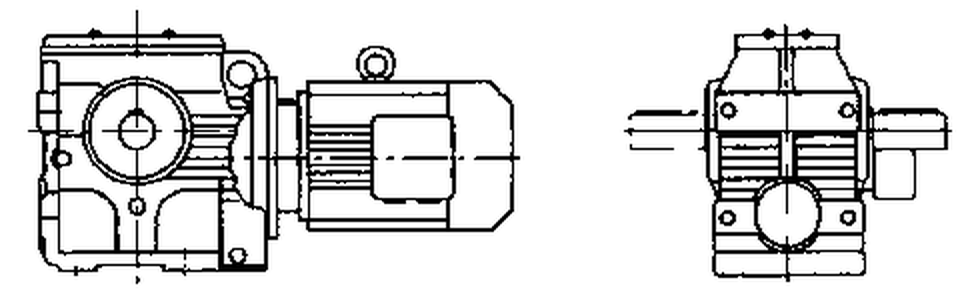
S47 Foot-Mount, Solid Output Shaft
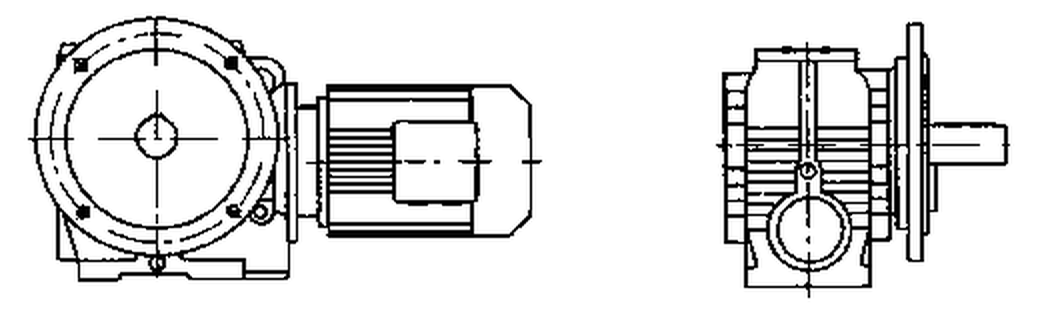
SF47 B5 Flange, Solid Output Shaft
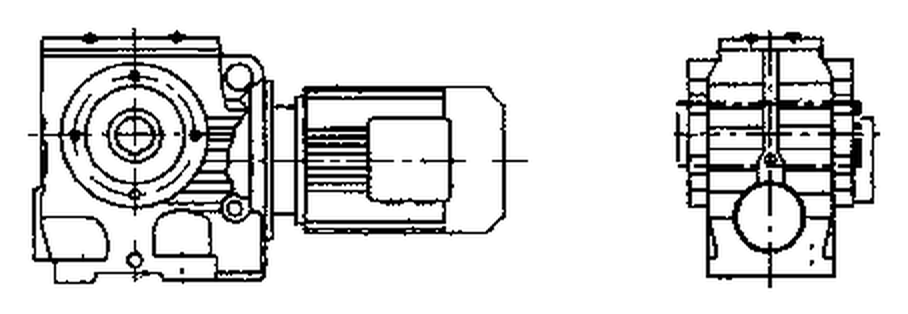
SA47 Shaft-Mounted, Hollow Bore
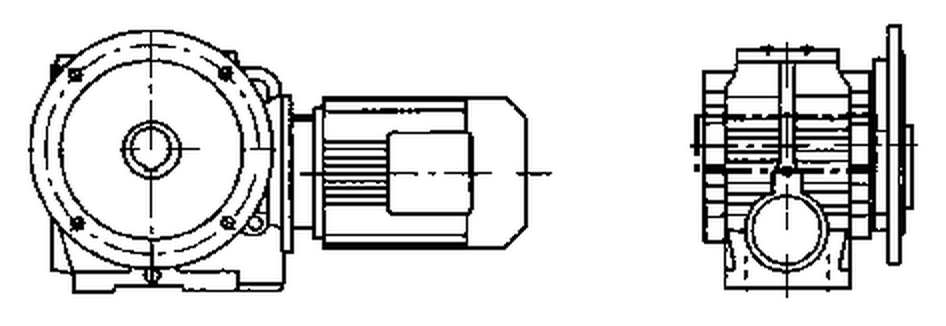
SAF47 B5 Flange + Hollow Bore
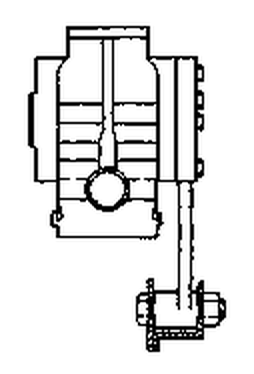
SAT47 Torque-Arm, Hollow Bore
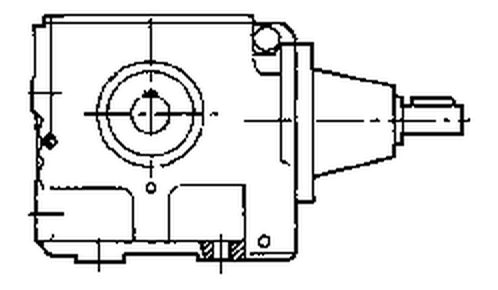
SA47-SZ Input Shaft Only
| Industry Sector | Typical Application |
|---|---|
| Printing & Packaging | Ink fountain drives, foil-stamping unit feeds, and web-tension dancers on commercial printing presses. |
| Food & Beverage Lines | Filling nozzle indexing, label applicator drives, and capping machine torque heads in bottling plants. |
| Pharmacy Production | Tablet coating pan drives and blister-feeder index units where validated quiet operation is a regulatory expectation. |
| Small Conveyors | Checkout belt drives, postal-sorting induction feeds, and small-parts accumulation lines. |
A soft-drink bottler replaced worn worm-only reducers on 12 capping heads with EP-S47 helical-worm units. The helical input stage raised efficiency from 62% to 79%, reducing heat in the cap-torque-sensing circuit that was causing nuisance torque-trip alarms. After 14 months of three-shift operation, zero torque alarms attributable to drive overheating have been recorded.
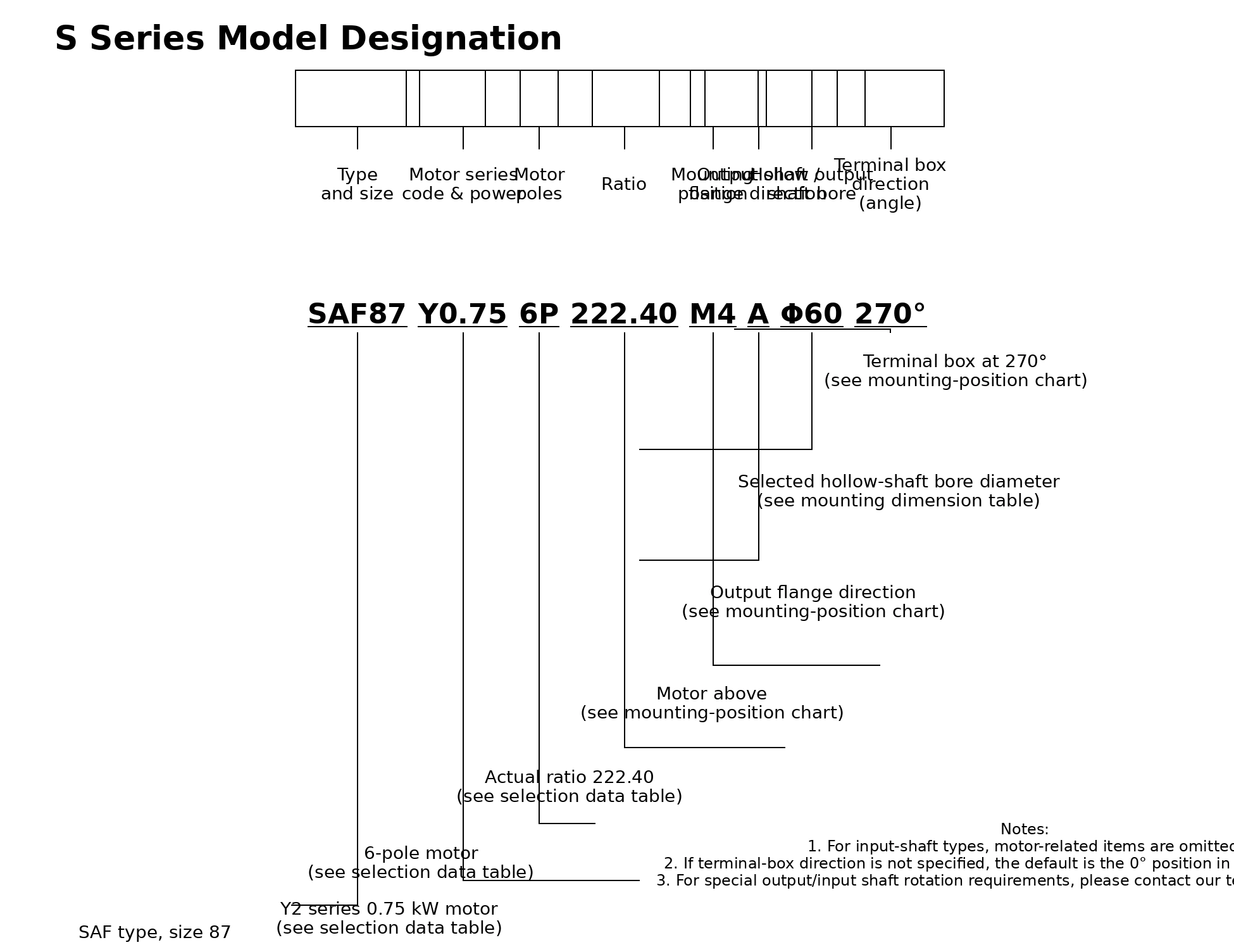
Every element of the S-series order code defines a specific product attribute. The example below shows a 1.5 kW, torque-arm, hollow-bore unit in mounting position M1:
EP - S47 - SAT - Y - 2 - 1.5 - 4P - M1
| Code Element | Meaning |
|---|---|
| EP | Brand identifier — Ever Power |
| S47 | Series and frame size — S-series helical-worm |
| SAT | Structural type: torque-arm, hollow-bore output |
| Y | Motor type: Y-series IEC standard induction motor |
| 2 | Number of gear stages (helical + worm) |
| 1.5 | Motor rated power in kW |
| 4P | Motor pole count (1,450 rpm at 50 Hz) |
| M1 | Mounting position (1 of 6 standard positions) |
Switching from a worm-only reducer to the EP-S47 helical-worm design is one of the most cost-effective energy-efficiency improvements available for continuous-duty drives. To quantify the saving for your specific duty cycle, send us your motor nameplate data and duty-cycle details via the inquiry form — we will calculate the annual energy and maintenance saving free of charge.
Audible noise is evidence to investigate, but fault location depends on whether the sound tracks speed, torque or the machine structure.
Flexible couplings accommodate limited relative movement, but poor shaft alignment still affects bearings and seals.
Oil observed on a housing may have traveled from a vent, joint or shaft seal; finding the first wet point is essential.