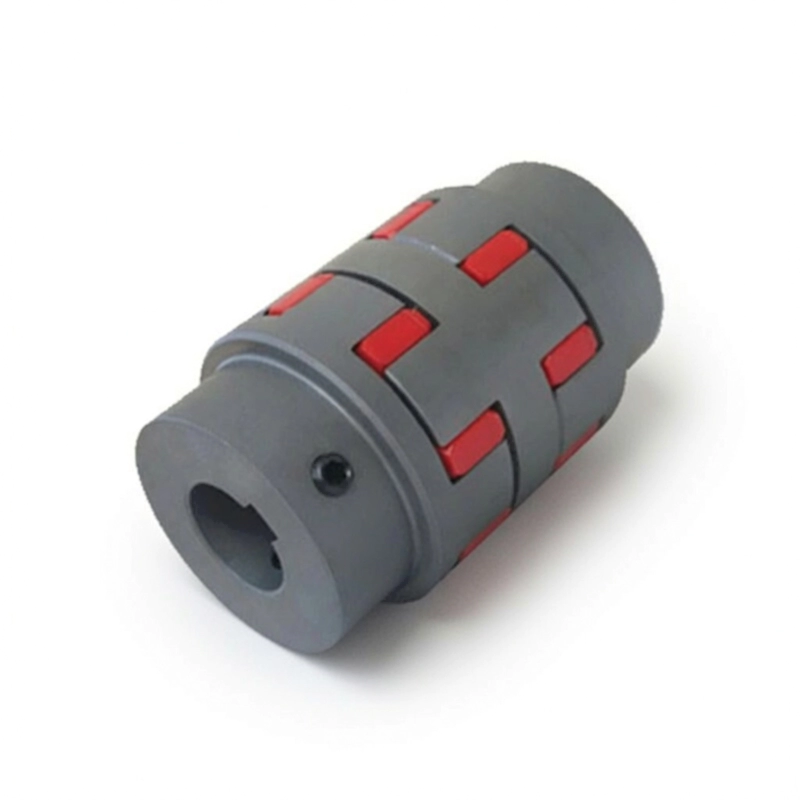
EP-S Double Elastomer Jaw Flexible Coupling — Superior Misalignment Compensation
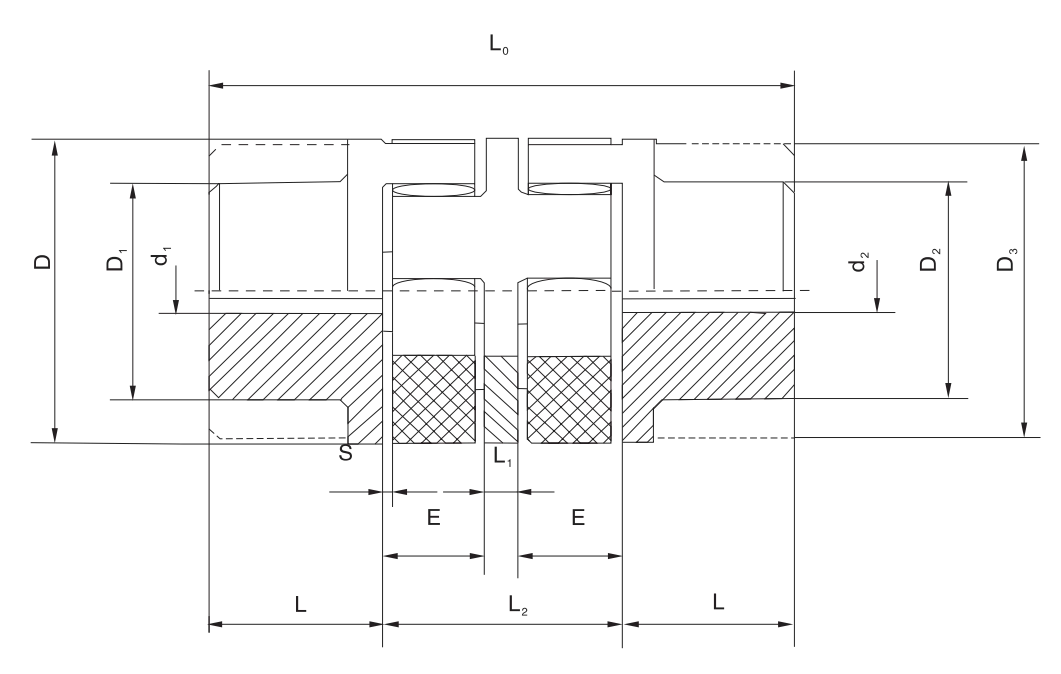
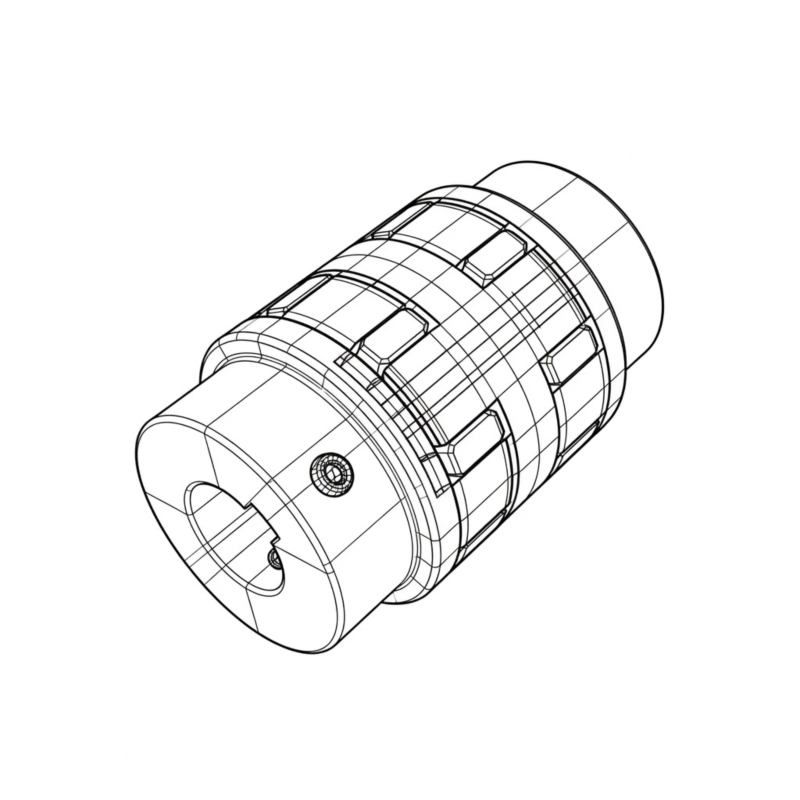
Where installation conditions make precise shaft alignment difficult or where thermal growth introduces significant misalignment during operation, the EP-S Double Elastomer Jaw Flexible Coupling provides a robust engineering answer. Its three-part, double-section architecture places two independent polyurethane elastomeric elements in series between the driving and driven hubs. This arrangement multiplies the angular and axial compensation capacity compared with a single-element coupling and dramatically reduces the reaction forces transmitted to shaft bearings and adjacent gearboxes.
The double elastomer design also provides improved vibration damping across a broader frequency band, since each elastomeric stage attenuates a different portion of the vibration spectrum. Operating noise is correspondingly lower than in equivalent single-element designs. Because the intermediate spacer body separates the two elastomeric zones, the EP-S can accommodate relatively large axial displacement without generating significant axial bearing loading. The marking convention is the same as for the EP-A, allowing direct size cross-reference between the two series. Standard elastomer hardness is 92 ShA; 98 ShA elements may also be fitted to the same hubs when higher torque capacity is required.
Key Features & Design Characteristics
⚙
Elastomer damping
The resilient spider helps absorb shock and torsional vibration between the driving and driven hubs.
✓
Lubrication-free element
The elastomeric transmission element does not require routine grease lubrication.
⇄
Compact hub arrangement
The jaw-style construction provides a short, practical connection for many motor-to-machine layouts.
Simple service access
Spider condition, hub fit and alignment can be checked during normal maintenance without complex disassembly procedures.
Structural Characteristics
- Three-part double-section design — large installation misalignment compensation.
- Vibration damping and noise reduction across a broad frequency band.
- Low stress generation on adjacent components from small deviations.
- Extended working life of neighbouring bearings, seals, and gearboxes.
- Marking convention identical to EP-A for easy cross-series reference.
- Standard 92 ShA elastomers; 98 ShA available for elevated torque applications.
- Angular compensation up to 1.5°; radial and axial compensation as per size table.
Technical Specifications — EP-S Series
| Model | Torque (N·m) | Speed (rpm) | Bore d (mm) | D (mm) | E (mm) | Radial comp. (mm) | Axial comp. (mm) |
|---|
| EP19S | 10 | 19000 | 6–25 | 40 | 16 | 0.65 | 1.2 |
| EP24S | 35 | 14000 | 8–35 | 55 | 18 | 0.89 | 1.4 |
| EP28S | 95 | 11800 | 10–40 | 65 | 20 | 1.00 | 1.5 |
| EP38S | 190 | 9500 | 12–48 | 80 | 24 | 1.15 | 1.8 |
| EP42S | 265 | 8000 | 14–55 | 95 | 26 | 1.26 | 2.0 |
| EP48S | 310 | 7100 | 15–60 | 105 | 28 | 1.36 | 2.1 |
| EP55S | 410 | 6300 | 20–70 | 120 | 30 | 1.52 | 2.1 |
| EP65S | 625 | 5600 | 22–75 | 135 | 35 | 1.75 | 2.6 |
| EP75S | 1280 | 4750 | 30–60 | 160 | 40 | 2.00 | 3.0 |
| EP90S | 2400 | 3750 | 40–100 | 200 | 45 | 2.50 | 3.4 |
Angular compensation: 1.5° for all models. All values for 92 ShA elastomers.
Ideal Applications for the EP-S
The EP-S is the preferred coupling wherever shaft alignment cannot be held to tight tolerances, or where vibration isolation between the driver and driven machines is a key requirement. Representative applications include:
- Diesel and gas engine drives: the double elastomer absorbs firing impulses and limits torsional vibration transmission to generators or pumps.
- Wet or chemically aggressive environments: polyurethane resists oils, coolants, and mild chemicals better than rubber.
- Long drive trains: temperature differences between driver and driven ends cause differential thermal expansion; the EP-S accommodates the resulting misalignment without generating harmful bearing loads.
- Retrofit applications: replaces rigid couplings where bearing failures indicate excessive misalignment.
- Compressor and blower drives: damps torsional pulsations and reduces acoustic noise transmission.
For flanged connections to heavy machinery, consider the EP-SF/EP-DF single and double flange jaw coupling. See the complete coupling portfolio for all options.
Customer Reviews & Case Studies
Netherlands — Gas Engine Generator Set
A combined heat and power plant operator in Groningen replaced single-element couplings on four 450 kW gas engine-generator units with EP-S couplings. Measured vibration velocity at the generator bearing housing fell by 62 %, and generator bearing replacements have been eliminated entirely in two years of operation.
★★★★★
"The improvement in generator reliability paid back the coupling cost within three months." — Operations Manager
Switzerland — Precision Pump OEM
A pump manufacturer near Zürich specified EP-S couplings across a chemical dosing pump range where motor-to-pump misalignment varied between installations. The double elastomer design eliminated seal failures that had been attributed to shaft radial loading from misaligned couplings.
★★★★★
"Seal replacement intervals extended from six months to well beyond two years." — Engineering Manager
Sweden — Industrial Ventilation
An industrial ventilation contractor in Gothenburg installed EP-S couplings on large fan drives in a steel processing plant. The couplings absorbed the vibration and thermal expansion of the duct system, and acoustic measurements confirmed a reduction in transmitted structure-borne noise to adjacent offices.
★★★★☆
"Straightforward to install and the noise improvement was immediately noticeable." — Site Foreman
Frequently Asked Questions
How much more misalignment can the EP-S handle compared with the EP-A?
The double-section architecture of the EP-S approximately doubles the permitted radial and axial compensation values for a given size, while the angular limit of 1.5° applies to both types. The real advantage of the EP-S lies in its ability to accommodate radial offsets and axial displacements that would generate damaging bearing loads in a single-element coupling.
Can both elastomeric elements be renewed without removing the shafts?
Yes. The intermediate spacer body sits between the two hub-and-spider assemblies. With the drive isolated, the spacer and both spiders can be removed radially or axially — depending on the space available — and new elements fitted without the need to move either hub axially along its shaft. Always verify there is adequate working clearance before starting the procedure.
Is the EP-S suitable for drives with large temperature differentials?
Thermal expansion misalignment is one of the primary design targets of the EP-S. When the driver and driven machine operate at significantly different temperatures — for example a cold-start diesel engine coupled to a warm generator — differential expansion creates progressive radial offset during warm-up. The EP-S accommodates this without generating harmful bearing loads or elevated coupling wear.
What is the angular compensation limit of the EP-S?
The angular compensation limit is 1.5° for all EP-S models, consistent across the entire size range from EP19S to EP90S. Note that this limit applies to the total angular misalignment across the coupling; in a double-section design each elastomeric stage accommodates approximately half the total angle.
How does the double elastomer design reduce bearing loads?
A single elastomeric coupling generates a radial restoring force proportional to the shaft offset. By placing two elastomeric stages in series through an intermediate body, the restoring force on each shaft bearing is approximately halved for the same total radial offset. This reduction in bearing radial load directly extends L10 bearing life — theoretically by a factor approaching eight if the bearing life equation is applied, because bearing life varies inversely with the cube of the applied radial load.
Enquire About the EP-S for Your Application
EP supplies the EP-S to drive system OEMs, engineering contractors, and industrial distributors. Custom bore specifications, special elastomers, and technical support for selection calculations are available. Visit the jaw coupling section for the full range or the coupling catalogue for a broader selection.
Get in Touch for a Quotation
Applications
◆
Pumps & fans
Used in motor-driven rotating equipment where compact size and vibration damping are useful.
⚙
Conveyors & packaging
Applicable to start-stop machinery where shock absorption and straightforward maintenance are valued.
⇄
HVAC & utilities
Suitable for auxiliary drives where shaft alignment and elastomer condition can be checked during service.
✓
General automation
Considered for industrial motion systems when torque, bore size, speed and misalignment remain within the selected model limits.