


EP-F Flange Type Jaw Flexible Coupling — Four Variants for Every Flange Connection
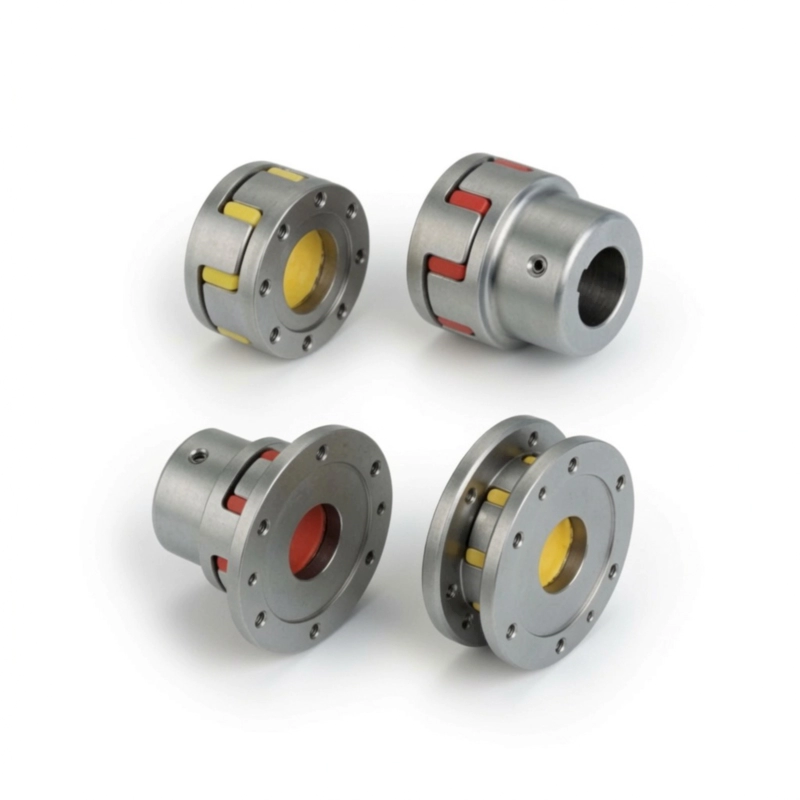
The EP-F series integrates the jaw flexible coupling principle with a flanged hub, creating a versatile family designed explicitly for heavy-machinery applications where one or both sides of the drive connection is a machined bolt flange rather than a plain shaft bore. Four structural sub-types — A, B, C, and D — address the different installation geometries encountered in the field, from straightforward flange-and-shaft assemblies to highly confined spaces where the machinery cannot be moved at all during maintenance.
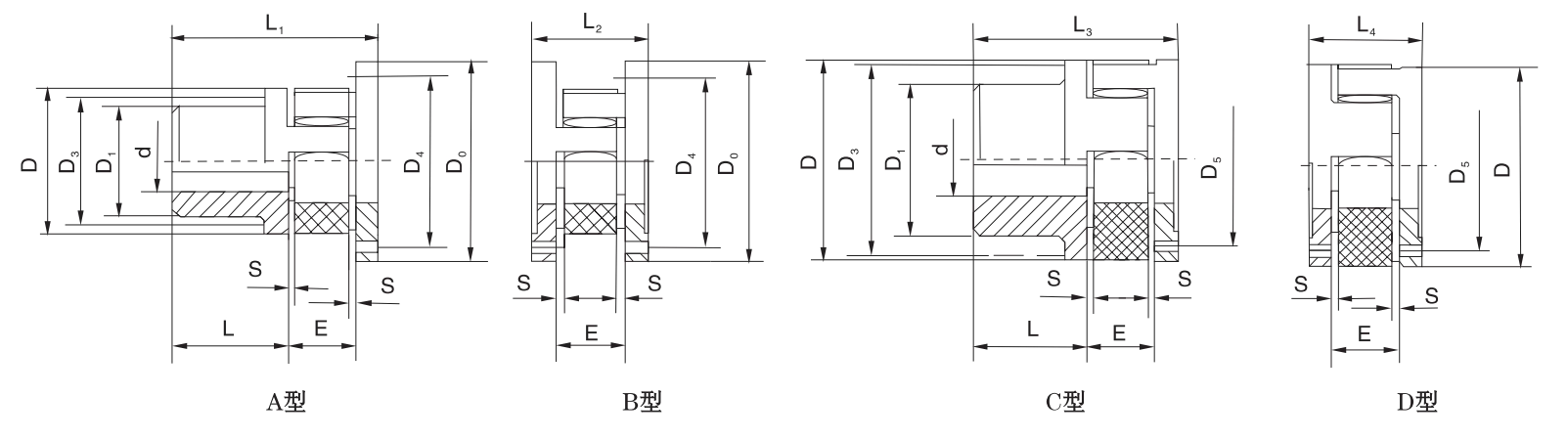
EP-F-A and EP-F-C are suitable for connecting a flange directly to a shaft — the flanged hub bolts to the machine flange while the plain hub slides onto the shaft in the conventional way. This makes them the standard choice for pump-to-motor connections, gearbox output flanges coupled to a secondary shaft, and similar arrangements where one side of the drive has a bolt-circle flange and the other a plain shaft.
EP-F-B and EP-F-D use a double-flange structure that permits radial installation from both ends simultaneously. Neither machine needs to be moved axially, making B and D types the preferred choice for confined installations — between-bearing shaft drives, wall-constrained engine rooms, and retrofit projects where repositioning the machinery is not viable. Once the bolts of each radial flange are released, the elastomeric spider can be withdrawn and renewed quickly, minimising downtime. The C and D sub-types have a slightly smaller outer diameter, which is useful where space between the coupling flanges and the machine housing is limited. The D type can additionally be manufactured to a customer-specific special flange, offering maximum design freedom.
Key Features & Design Characteristics
Elastomer damping
The resilient spider helps absorb shock and torsional vibration between the driving and driven hubs.
Lubrication-free element
The elastomeric transmission element does not require routine grease lubrication.
Compact hub arrangement
The jaw-style construction provides a short, practical connection for many motor-to-machine layouts.
Simple service access
Spider condition, hub fit and alignment can be checked during normal maintenance without complex disassembly procedures.
Sub-Type Selection Guide

| Type | Connection | Installation direction | Notes |
|---|---|---|---|
| EP-F-A | Flange to shaft | Axial | Standard flange-and-shaft connection |
| EP-F-B | Flange to flange | Radial (both ends) | Fast elastomer swap; drive end machinery not moved |
| EP-F-C | Flange to shaft | Axial | Smaller outer diameter than A type |
| EP-F-D | Flange to flange | Radial (both ends) | Smaller OD; custom special flanges available |
Technical Specifications — EP-F Series (all sub-types share these parameters)
| Model | Torque (N·m) | Speed (rpm) | Bore d (mm) | D (mm) | D0 (mm) | D1 (mm) | D3 (mm) | E (mm) | S (mm) |
|---|---|---|---|---|---|---|---|---|---|
| EP24F | 35 | 14000 | 8–35 | 55 | 80 | 40 | 55 | 18 | 2 |
| EP28F | 95 | 11800 | 10–40 | 65 | 100 | 48 | 65 | 20 | 2.5 |
| EP38F | 190 | 9500 | 12–48 | 80 | 115 | 66 | 78 | 24 | 3 |
| EP42F | 265 | 8000 | 14–55 | 95 | 140 | 75 | 94 | 26 | 3 |
| EP48F | 310 | 7100 | 15–60 | 105 | 150 | 85 | 104 | 28 | 3.5 |
| EP55F | 410 | 6300 | 20–70 | 120 | 175 | 98 | 118 | 30 | 4 |
| EP65F | 625 | 5600 | 22–75 | 135 | 190 | 115 | 134 | 35 | 4.5 |
| EP75F | 1280 | 4750 | 30–90 | 160 | 215 | 135 | 158 | 40 | 5 |
| EP90F | 2400 | 3750 | 40–100 | 200 | 260 | 160 | 180 | 45 | 5.5 |
| EP100F | 3300 | 3350 | 50–110 | 225 | 285 | 180 | 200 | 50 | 6 |
| EP110F | 4800 | 3000 | 60–125 | 255 | 330 | 200 | 230 | 55 | 6.5 |
| EP125F | 6650 | 2650 | 60–145 | 290 | 370 | 230 | 265 | 60 | 7 |
| EP140F | 8600 | 2360 | 60–165 | 320 | 410 | 256 | 300 | 65 | 7.5 |
| EP160F | 12800 | 2000 | 80–190 | 370 | 460 | 290 | 345 | 75 | 9 |
| EP180F | 18650 | 1800 | 85–220 | 420 | 520 | 325 | 400 | 85 | 10.5 |
Structural Characteristics — All F Sub-Types
- Suitable for heavy-machinery flange connections.
- A and C types — flange-to-shaft, axial installation.
- B and D types — radial installation from both ends; elastomer renewal without axial machine movement.
- C and D types feature a smaller outer diameter for space-constrained installations.
- D type available with customer-specific special flange geometry.
- All types: bore, keyway, sleeve, and flange specifications customisable to order.
- Covers sizes EP24F to EP180F, torque 35 to 18,650 N·m.
Industries and Applications
The EP-F family is deployed wherever a flange interface is the natural connection point on one or both sides of the drive. Typical sectors include heavy industrial process plant, power generation, marine, and offshore industries. Key application groups include:
- Process pumps (API 610 / ISO 13709): overhung and between-bearing centrifugal pumps with SAE or DIN bolt flanges.
- Diesel generator sets: flywheel flange-to-generator shaft connections where shock absorption from firing impulses is critical.
- Marine main and auxiliary drives: gearbox output flange to propeller shaft, bilge and ballast pump drives.
- Mixer and agitator drives: top-entry agitators where the coupling sits above the gearbox flange in a space-constrained arrangement.
- Offshore and subsea support machinery: where corrosion resistance and minimal maintenance access are key requirements.
For a shaft-to-shaft flanged option, see the EP-SF/EP-DF single and double flange coupling. The full range is available in the coupling catalogue.
Customer Reviews & Case Studies
Netherlands — Diesel Generator OEM
A Rotterdam-based generator manufacturer used EP-F-A couplings to connect diesel engine flywheel flanges to alternator shafts across their 200–1200 kVA range. The polyurethane spider reduced torsional shock transmission to the alternator windings, extending alternator bearing life noticeably compared with the rigid disc coupling previously specified.
★★★★★
“The EP-F-A became our standard across the whole gen-set range after the first season.” — Product Manager
Germany — Process Pump Manufacturer
A chemical process pump OEM in Ludwigshafen standardised on the EP-F-B for their API 610 between-bearing pumps. The radial assembly principle allowed field engineers to replace worn elastomers in under 30 minutes without disturbing the pump or motor alignment — a significant advantage in the continuous-process plants where the pumps operate.
★★★★★
“Elastomer replacement time reduced from four hours to 25 minutes.” — Service Engineer
Norway — Offshore Support Vessel
An offshore vessel operator based in Bergen specified EP-F-D couplings for thruster gearbox-to-motor connections where the machinery room limited the available space. The smaller outer diameter of the D type cleared the housing wall by 8 mm — just enough to allow installation in a location where the larger A or B type would not have fitted.
★★★★★
“The custom flange option on the D type solved a design problem that had held us up for weeks.” — Vessel Engineer
Frequently Asked Questions
When should I choose EP-F-A over EP-F-B?
Use EP-F-A when one side of the drive has a bolt-circle flange and the other a plain shaft, and when there is sufficient axial clearance to slide the coupling body onto the shaft during installation. Use EP-F-B when both sides have flanges and you want the maintenance advantage of radial assembly — particularly important when the machinery is piped or bolted in place and cannot be moved axially during service.
Can the EP-F-D be made with any custom flange geometry?
The EP-F-D can be manufactured to customer-specific flange drawings, covering non-standard bolt-circle diameters, bolt quantities, flange thicknesses, and outer diameters. This makes the D type the most flexible option in the F series for retrofit applications where the machine flange was designed to a non-standard specification. Contact us with your flange drawing for a technical feasibility assessment and quotation.
Is the elastomeric spider the same across all F sub-types for the same size?
Yes — for a given size number (e.g., EP65), the polyurethane spider is identical across A, B, C, and D sub-types. This means a single spare spider covers all four variants, simplifying inventory management when multiple coupling types are used within the same installation or plant.
How do I specify an EP-F coupling when ordering?
The ordering reference includes: size code + F + sub-type letter (+ bore if sub-type A or C). For example: EP42F-A-35 is an EP42 size, A sub-type, with a 35 mm bore. For B and D types, both hub bore diameters are specified separately. Include your required keyway dimensions, sleeve type, and any special flange requirements when contacting us for a quotation.
What is the maximum bore available in the EP-F range?
The largest model in the F series, the EP180F, accommodates bore diameters from 85 mm up to 220 mm with a nominal torque of 18,650 N·m and a maximum speed of 1,800 rpm. Custom bore machining within the stated range is available for all sub-types.
Discuss Your Flange Drive Requirements
EP works with OEM manufacturers, engineering firms, and international distributors on flange coupling projects across all industrial sectors. Custom flanges, bore specifications, special elastomers, and volume pricing are all available. Share your application details and drawings with our technical team for a comprehensive recommendation.
Applications
Pumps & fans
Used in motor-driven rotating equipment where compact size and vibration damping are useful.
Conveyors & packaging
Applicable to start-stop machinery where shock absorption and straightforward maintenance are valued.
HVAC & utilities
Suitable for auxiliary drives where shaft alignment and elastomer condition can be checked during service.
General automation
Considered for industrial motion systems when torque, bore size, speed and misalignment remain within the selected model limits.