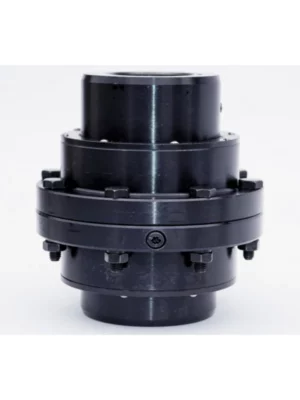
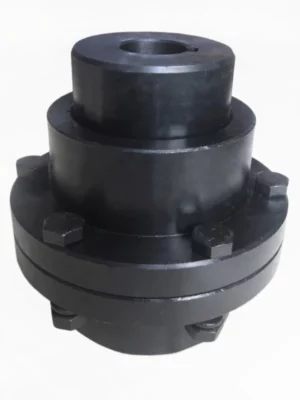
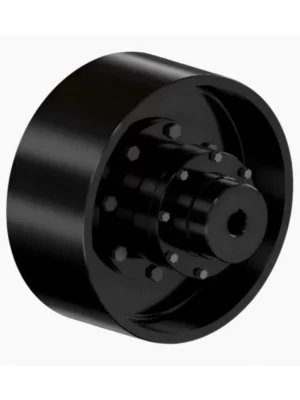
EP-A Standard Jaw Flexible Coupling — Compact, Low-Inertia Drive Solution
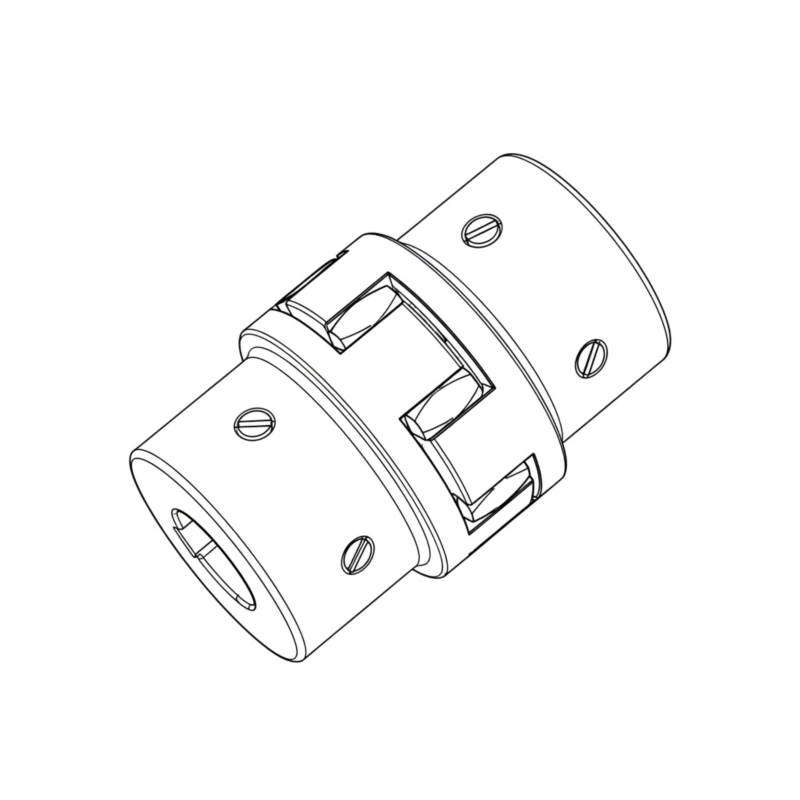
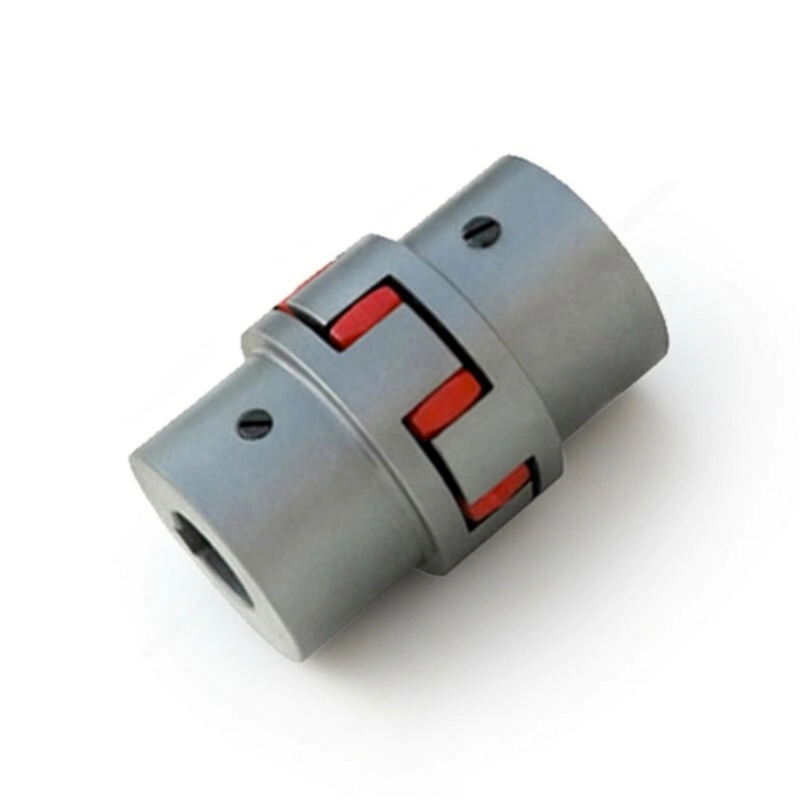
The EP-A Standard Jaw Flexible Coupling is the workhorse of the EP jaw coupling range, combining a compact envelope with exceptional shock absorption. Its engineering-plastic elastomeric spider is constrained by the claw geometry on both hubs, preventing the internal deformation and centrifugal expansion that can occur in less refined designs. The large concave-convex claw profile distributes tooth-face pressure uniformly, so the involute teeth resist wear and maintain dimensional integrity even after sustained overloads. Axial plug-in assembly means no special tooling is required during installation — the two hubs simply slide onto their respective shafts and the spider drops into place.
Two elastomer hardness grades are available: 92 ShA for standard damping and 98 ShA for elevated torque transmission — the stiffer grade increases nominal torque capacity by approximately 70 %. Both grades are compatible with the same hub hardware, giving engineers a straightforward upgrade path without redesigning the coupling interface. Bore and keyway dimensions can be machined to customer specification across the full model range, from the smallest TS14A (bore 6–16 mm) up to TS180A (bore 85–200 mm).
Key Features & Design Characteristics
⚙
Elastomer damping
The resilient spider helps absorb shock and torsional vibration between the driving and driven hubs.
✓
Lubrication-free element
The elastomeric transmission element does not require routine grease lubrication.
⇄
Compact hub arrangement
The jaw-style construction provides a short, practical connection for many motor-to-machine layouts.
Simple service access
Spider condition, hub fit and alignment can be checked during normal maintenance without complex disassembly procedures.
Key Structural Features
- Compact dimensions and low rotational inertia — ideal for servo and positioning applications.
- Polyurethane elastomeric spider absorbs shock, dampens vibration, and resists abrasion; working temperature −35 °C to +800 °C.
- Claw-block elastic limit prevents internal and centrifugal deformation under overload.
- Axial plug-in installation — no special tooling required.
- 92 ShA standard; 98 ShA option raises nominal torque by ~70 %.
- Bore, keyway, and sleeve type configurable per customer requirement.
- Zero maintenance design throughout service life.
Technical Specifications — EP-A Series
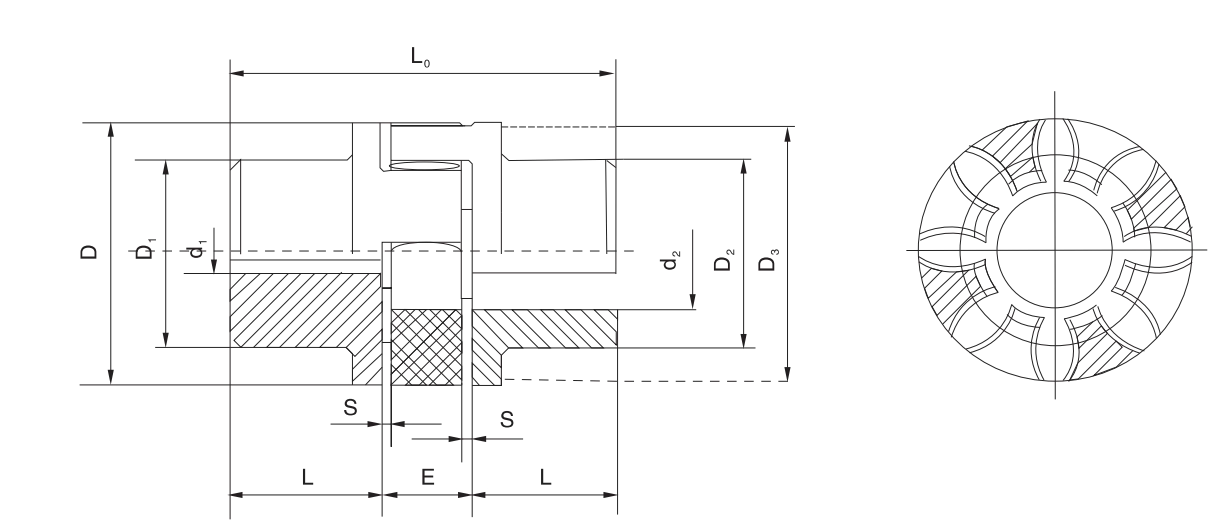
| Model | Torque (N·m) | Speed (rpm) | Bore d (mm) | L (mm) | D (mm) | E (mm) |
|---|
| EP14A | 7.5 | 19000 | 6–16 | 11 | 35 | 13 |
| EP19A | 10 | 14000 | 6–19 | 25 | 66 | 16 |
| EP24A | 35 | 10600 | 8–24 | 30 | 78 | 18 |
| EP28A | 95 | 8500 | 8–28 | 35 | 90 | 20 |
| EP38A | 190 | 9500 | 10–38 | 45 | 114 | 24 |
| EP42A | 265 | 8000 | 10–42 | 50 | 126 | 26 |
| EP48A | 310 | 7100 | 10–48 | 56 | 140 | 28 |
| EP55A | 410 | 6300 | 15–55 | 65 | 160 | 30 |
| EP65A | 625 | 5600 | 15–65 | 75 | 185 | 35 |
| EP75A | 1280 | 4750 | 20–75 | 85 | 210 | 40 |
| EP90A | 2400 | 3750 | 30–90 | 100 | 245 | 45 |
| EP100A | 3300 | 3350 | 30–115 | 110 | 270 | 50 |
| EP110A | 4800 | 3000 | 40–125 | 120 | 295 | 55 |
| EP125A | 6650 | 2650 | 40–145 | 140 | 340 | 60 |
| EP140A | 8600 | 2360 | 40–160 | 155 | 375 | 65 |
| EP160A | 12800 | 2000 | 60–180 | 175 | 425 | 75 |
| EP180A | 18650 | 1800 | 85–200 | 195 | 475 | 85 |
Typical Industrial Applications
The EP-A is a versatile coupling suited to a wide spectrum of industrial drive trains. Its compact geometry makes it a first choice wherever installation space is restricted, while the maintenance-free elastomeric spider lowers lifetime operating costs significantly compared with gear or chain couplings. Representative industries include:
- General mechanical engineering: pump and compressor drives, conveyor head drives, blower fans.
- Printing and packaging machinery: servo axes where low inertia preserves positioning accuracy.
- Food processing equipment: moisture-resistant polyurethane spider is easy to clean.
- Material handling: roller conveyor drives, belt drives, and palletiser units.
- HVAC systems: fan-to-motor connections in air-handling units.
For applications requiring greater misalignment compensation, consider the EP-S double-elastomer jaw coupling. For flange-to-shaft connections in heavy plant, the EP-F flange jaw coupling offers additional bolt-circle mounting flexibility.
Customer Reviews & Case Studies
Netherlands — Food & Beverage Processing
A bottling-line manufacturer in Breda replaced a rubber jaw coupling on their filling-machine servo axis with an EP-A unit. The lower inertia improved indexing repeatability from ±0.3° to ±0.08°, allowing line speed to increase by 12 % without additional servo tuning.
★★★★★
"The plug-in assembly took under five minutes per coupling. Maintenance intervals have been extended considerably." — Plant Engineer
Germany — Industrial Pump OEM
A centrifugal pump manufacturer near Munich standardised on the EP-A across their 22 kW to 160 kW product range. The 98 ShA elastomer option was selected for high-power models, eliminating a premature spider-wear issue that had affected the previous coupling supplier.
★★★★★
"Consistent bore tolerances across the entire range reduced our assembly time noticeably." — Procurement Manager
United Kingdom — Conveyor Systems Integrator
A system integrator in the West Midlands specified EP-A couplings throughout a large distribution-centre conveyor project. The zero-maintenance requirement was a primary selection criterion; after 18 months in continuous three-shift operation no elastomer replacements have been needed.
★★★★☆
"Good dimensional accuracy and competitive pricing on volume orders." — Project Buyer
Frequently Asked Questions
What is the difference between 92 ShA and 98 ShA elastomers for EP-A couplings?
92 ShA is the standard softer grade that delivers better shock absorption and vibration damping, making it the preferred choice for most general drive applications. 98 ShA is the stiffer high-torque grade — using 98 ShA increases the nominal torque capacity by approximately 70 % compared with the table values, making it suitable for heavy-duty or torsionally stiff drive trains. Both grades fit the same hub hardware.
Can EP-A couplings be used in food-processing environments?
The polyurethane elastomeric spider resists moisture, oils, and mild cleaning agents, making EP-A couplings broadly compatible with food and beverage processing environments. For direct food-contact applications, verify the specific elastomer compound against applicable hygiene standards in your region.
How do I select the correct EP-A model size?
Calculate the design torque as: Design Torque = Rated Motor Torque × Service Factor. Service factors range from 1.5 for smooth loads up to 2.5 or higher for heavy shock loads. Select the smallest EP-A model whose nominal torque exceeds the design torque, then verify the bore range covers both shaft diameters. Use the 98 ShA elastomer if an intermediate size would suffice with the upgraded grade.
Is the elastomeric spider field-replaceable without disturbing the shafts?
Yes — this is one of the primary maintenance advantages of the jaw coupling design. Provided sufficient axial clearance exists between the two hub faces, the spider can be slid out radially or axially and a new element fitted without moving either hub along the shaft. Always power down the drive completely before carrying out any maintenance.
What misalignment values can the EP-A accommodate?
The EP-A tolerates small angular misalignment (typically up to 1°) and small parallel offset through the elastic deformation of the polyurethane spider. It is not designed to compensate large or systematic installation misalignment; always align shafts as accurately as possible to maximise elastomer service life. If your application involves larger angular or parallel misalignment, the EP-S double-elastomer model provides significantly greater compensation capacity.
Request a Quote — B2B Partnerships Welcome
EP is an established supplier to OEM manufacturers, industrial distributors, and mechanical engineering contractors across Europe and beyond. Whether you require a small trial batch or a long-term supply arrangement, our technical and commercial teams are ready to discuss your requirements. Custom bore machining, special elastomer compounds, and non-standard sleeve configurations are all available.
Browse the full coupling range or explore the complete jaw coupling series for alternative models.
Contact Us for a Quotation
Applications
◆
Pumps & fans
Used in motor-driven rotating equipment where compact size and vibration damping are useful.
⚙
Conveyors & packaging
Applicable to start-stop machinery where shock absorption and straightforward maintenance are valued.
⇄
HVAC & utilities
Suitable for auxiliary drives where shaft alignment and elastomer condition can be checked during service.
✓
General automation
Considered for industrial motion systems when torque, bore size, speed and misalignment remain within the selected model limits.