SCS06 Aluminum Shaft Collar – 6 mm Bore Single Split Clamp Ring
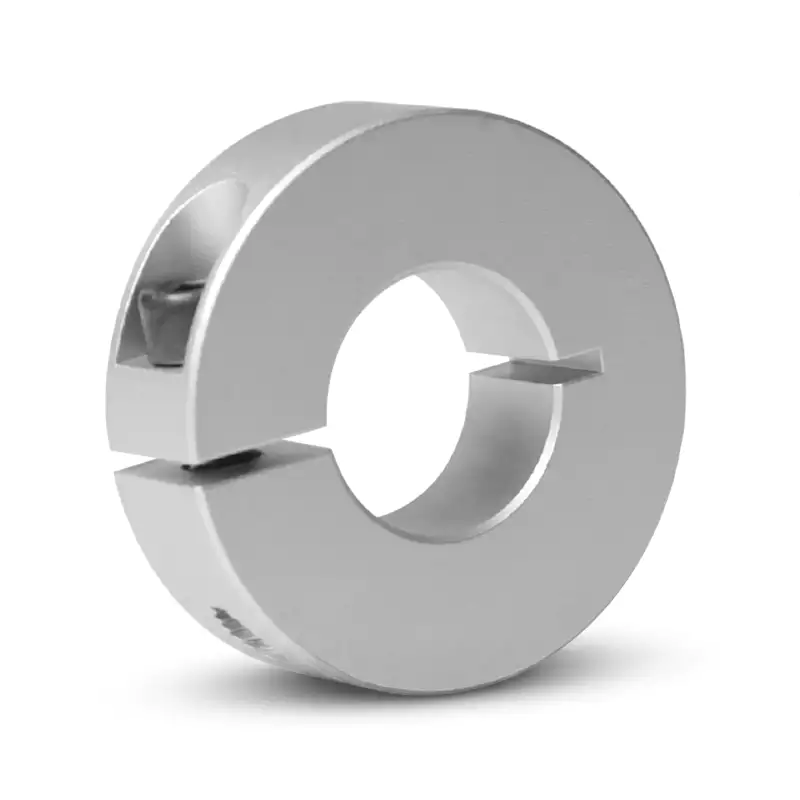
The SCS06 shaft collar is the entry-level model in EP's aluminium clamp-type collar series, purpose-built for 6 mm precision shafts used in instrumentation, miniature conveyor systems, optical positioning stages, and laboratory automation equipment. Machined from high-grade 6061-T6 aluminium alloy, it combines a featherweight profile with a corrosion-resistant surface finish that endures harsh wash-down and humid indoor environments equally well.
Unlike traditional set-screw collars that bite into the shaft surface and cause fretting damage, the SCS06 uses a single-slit, bolt-clamp mechanism: tightening the countersunk M4 socket-head screw draws the two collar faces together around the shaft, distributing clamping pressure uniformly across the full bore circumference. The result is zero shaft marring, full repositionability, and repeatable axial location with every installation cycle.
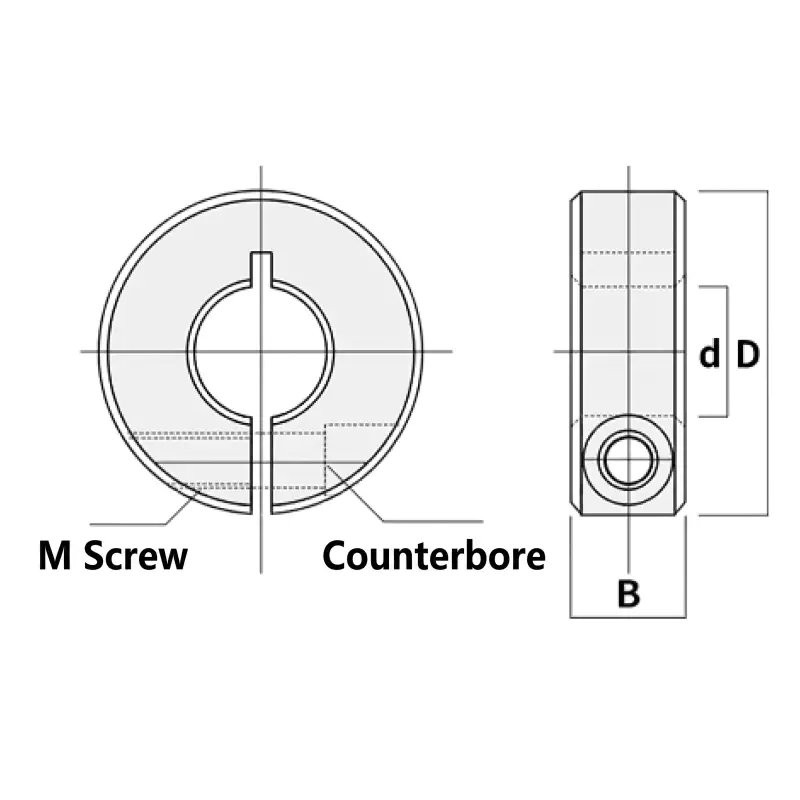
Key Specifications – SCS06
| Parameter |
Value |
Notes |
| Model |
SCS06 |
Single-split clamp type |
| Bore (d) |
6 mm |
Fits Ø6 shafts |
| Outer Diameter (D) |
20 mm |
Compact envelope |
| Width (B) |
10 mm |
Standard face width |
| Clamping Screw |
M4 socket head |
Countersunk, hex key drive |
| Slit Width (W) |
1 mm |
Narrowest in series |
| Keyway (K) |
None |
Standard; keyway available on request |
| Material |
Aluminium alloy |
Lightweight, corrosion-resistant |
Why the SCS06 Excels in Micro-Axis Positioning
At a bore-to-OD ratio of 1:3.33, the SCS06 offers a substantial clamping wall even at the smallest shaft size in the series. This geometry ensures that the M4 clamping bolt—operating at its rated tightening torque—generates radial grip forces well above the axial loads typical of precision instrument shafts, rotary encoders, and miniature stepper motor spindles.
⚡ Zero Shaft Damage
Uniform bore clamping replaces point-contact set screws, eliminating shaft indentation and fretting fatigue.
⚙ Narrowest Slit in Series
1 mm slit concentrates clamping energy, ideal where collar real estate is limited by adjacent components.
🛠 Tool-Free Repositioning
Loosen one hex-key bolt, slide to the new position, retighten — no special fixtures required in the field.
⚖ Corrosion Resistance
Aluminium alloy construction with surface treatment withstands humidity, light mist, and non-aggressive chemical exposure.
Primary Applications for 6 mm Bore Shaft Collars
The SCS06 finds its natural habitat wherever a 6 mm shaft must be positionally locked without adding meaningful rotational inertia. In laboratory and medical instrumentation, miniature carriage drives and sample-positioning gantries depend on shaft collars of this scale for sub-millimetre repeatability. In electronics manufacturing automation, pick-and-place axes, camera focus shafts, and PCB drilling spindles use the SCS06 to set hard travel limits with no risk of shaft damage during crash events.
Optical and photonics alignment stages are another key domain: the absence of a keyway means no stress-concentration notch that could introduce micro-vibration-induced axis drift. Where higher torque transmission is later required, a custom keyway (K=3 mm) can be machined upon order — simply provide your drawing to the EP engineering team via the contacts page.
Installation & Adjustment Guide
- Clean the shaft surface — remove oil, burrs, and oxide scale within the collar seating zone to maximise friction grip.
- Slide the SCS06 onto the shaft — the 1 mm slit allows the collar to open slightly without permanent deformation.
- Position axially — bring the collar face to the required stop location, referencing a depth gauge or adjacent component.
- Tighten the M4 screw incrementally — use a calibrated torque wrench set to the recommended value (typically 2.5 N·m for M4 socket-head screws in aluminium). Do not exceed rating to avoid thread strip-out.
- Verify runout — check collar face perpendicularity with a dial indicator if axial location tolerance is critical.
- Re-torque after first thermal cycle — aluminium's thermal expansion coefficient is higher than steel shafts; a re-check torque pass after initial heat exposure is recommended.
Pairing Two SCS06 Collars for Component Clamping
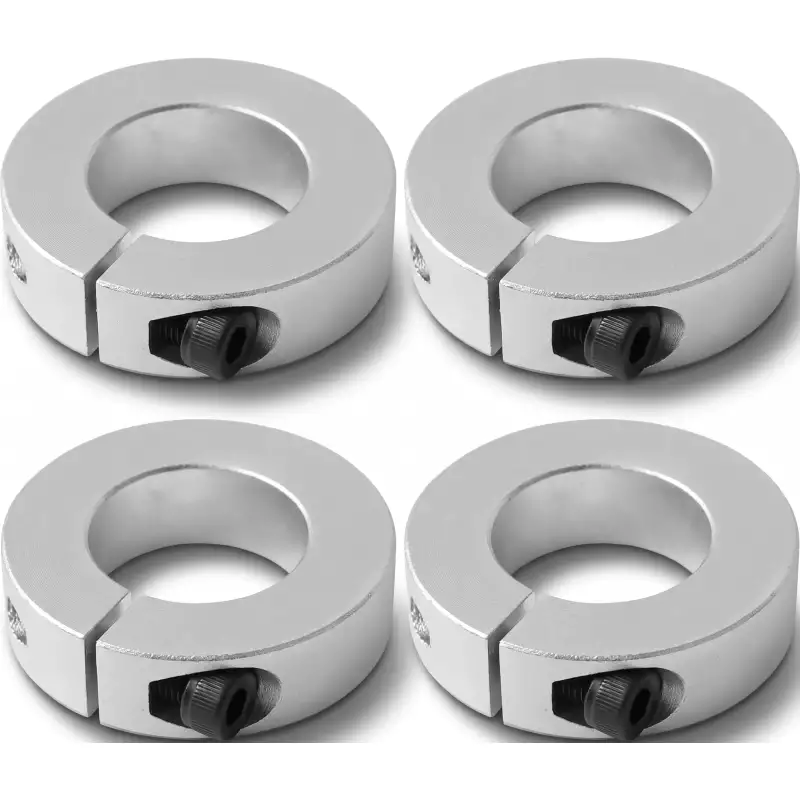
A common installation technique is to fit one SCS06 on each side of a lightweight component (such as a timing pulley hub or encoder disc) mounted on the 6 mm shaft. The paired collars sandwich the component, allowing front-to-back positional adjustment before final lock-down — a compact, adjustable axial clamping arrangement that outperforms press-fit solutions in prototype and short-run production environments. For this configuration, ensure the combined axial preload from both collars does not overstress the component's hub face; consult EP's engineering team if load calculations are needed.
Frequently Asked Questions – SCS06
Can the SCS06 be used on stainless steel shafts?
Yes. The aluminium collar is fully compatible with stainless steel, carbon steel, and hardened shafts. For high-humidity or salt-spray environments, request a surface-treated or anodised version to prevent galvanic corrosion at the aluminium-stainless interface.
What is the maximum operating temperature for the SCS06?
Standard aluminium alloy shaft collars are rated for continuous service from -30 °C to +120 °C. For higher-temperature applications, consult EP for stainless steel or carbon steel collar alternatives.
Is a keyway option available for the SCS06?
The standard SCS06 ships without a keyway. A 3 mm keyway can be machined to order. Submit your custom drawing via the contacts page and EP's engineering team will confirm feasibility and lead time.
What is the MOQ and lead time?
The minimum order quantity is 100 pieces. Standard lead time is quoted at order confirmation. Custom-dimension orders may require additional lead time; contact EP early in your project timeline.
Ready to Source the SCS06?
MOQ 100 pcs | Custom drawings welcome | Catalogue dimensions for reference only
Request a Quote