EP-B Enlarged Bore Jaw Flexible Coupling — Steel Hubs for Heavy-Load Drives
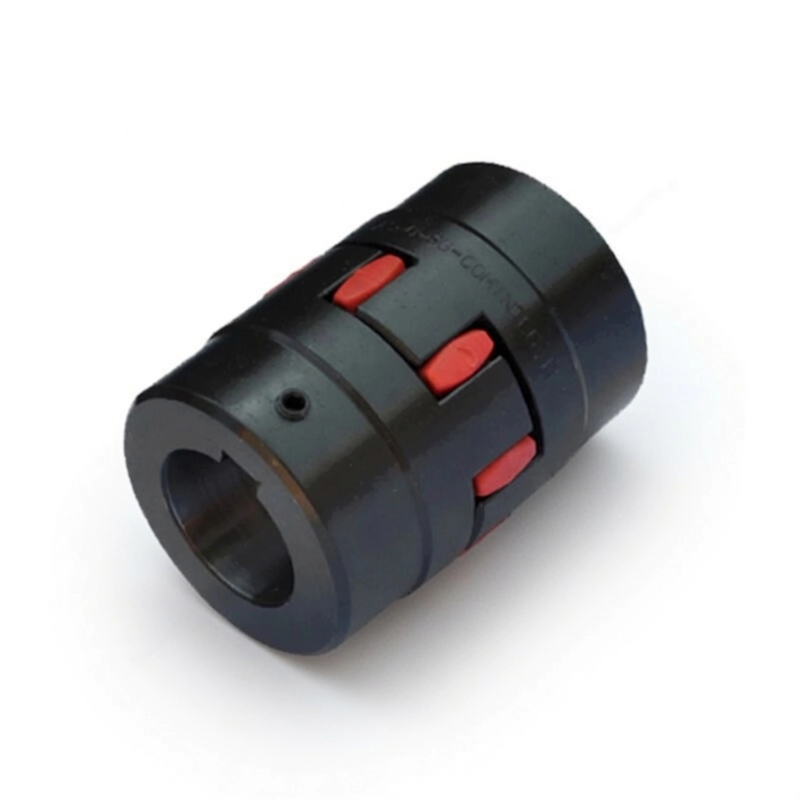
The EP-B Enlarged Bore Jaw Flexible Coupling extends the proven EP jaw-coupling platform to demanding heavy-duty applications where larger shaft diameters are the norm. By replacing the cast-iron or cast-aluminium hub of the standard EP-A with a steel hub, the EP-B resists the higher bending stresses associated with large-bore installations — particularly important in lifting machinery, rolling mills, and heavy construction equipment where both transmitted torque and shaft diameter are substantially greater than in general mechanical engineering.
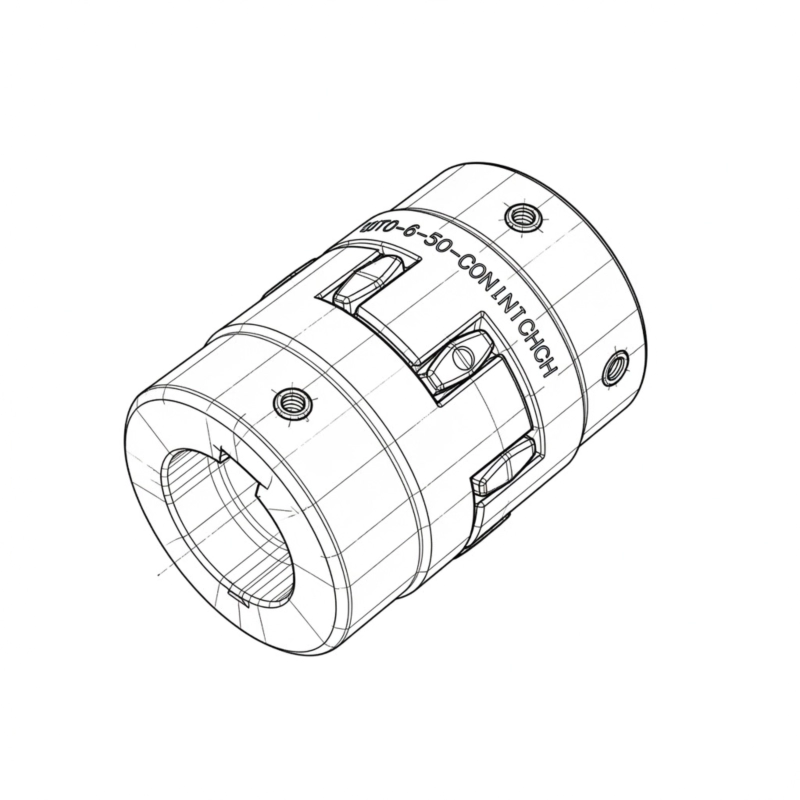
The overall coupling geometry and marking convention are identical to the EP-A, allowing engineers already familiar with the standard series to specify the EP-B with confidence. The elastomeric spider remains a polyurethane element rated at 92 ShA (nominal torque table values), and the same spider used in the EP-A fits the corresponding EP-B hub size, simplifying spare-parts inventory management. Maximum bore extends to Φ220 mm on the EP180B model, covering virtually all shaft sizes encountered in industrial drives up to 18,650 N·m.
Key Features & Design Characteristics
⚙
Elastomer damping
The resilient spider helps absorb shock and torsional vibration between the driving and driven hubs.
✓
Lubrication-free element
The elastomeric transmission element does not require routine grease lubrication.
⇄
Compact hub arrangement
The jaw-style construction provides a short, practical connection for many motor-to-machine layouts.
Simple service access
Spider condition, hub fit and alignment can be checked during normal maintenance without complex disassembly procedures.
Structural Characteristics
- Steel hubs — optimised for heavy-load drive units such as lifts, rolling mills, and construction machinery.
- Larger bore accommodation compared with EP-A, suited to installation scenarios requiring bigger shaft apertures.
- Marking and dimensioning system identical to EP-A, enabling direct cross-reference.
- Compact design with low moment of inertia despite the enlarged bore capability.
- Standard elastomeric spider hardness 92 ShA; nominal torque table based on 92 ShA values.
- Bore, keyway, and sleeve configurations per customer specification.
- Maintenance-free throughout service life.
Technical Specifications — EP-B Series
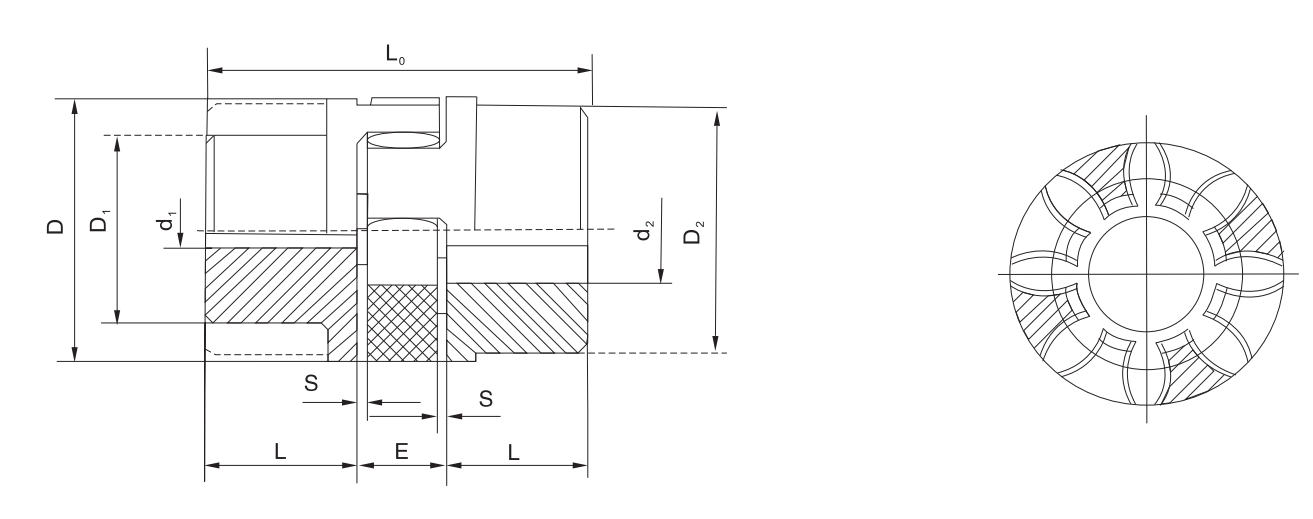
| Model | Torque (N·m) | Speed (rpm) | Bore d (mm) | L (mm) | D (mm) | E (mm) | Weight (kg) |
|---|
| EP19B | 10 | 19000 | 6–25 | 25 | 66 | 16 | 0.328 |
| EP24B | 35 | 14000 | 8–35 | 30 | 78 | 18 | 0.68 |
| EP28B | 95 | 11800 | 10–40 | 35 | 90 | 20 | 1.16 |
| EP38B | 190 | 9500 | 12–48 | 45 | 114 | 24 | 2.27 |
| EP42B | 265 | 8000 | 14–55 | 50 | 126 | 26 | 3.57 |
| EP48B | 310 | 7100 | 15–60 | 56 | 140 | 28 | 4.80 |
| EP55B | 410 | 6300 | 20–70 | 65 | 160 | 30 | 7.87 |
| EP65B | 625 | 5600 | 22–75 | 75 | 185 | 35 | 10.89 |
| EP75B | 1280 | 4750 | 30–90 | 85 | 210 | 40 | 17.73 |
| EP90B | 2400 | 3750 | 40–100 | 100 | 245 | 45 | 29.60 |
| EP100B | 3300 | 3350 | 50–110 | 110 | 270 | 50 | 43.0 |
| EP110B | 4800 | 3000 | 60–125 | 120 | 295 | 55 | 58.6 |
| EP125B | 6650 | 2650 | 60–145 | 140 | 340 | 60 | 88.4 |
| EP140B | 8600 | 2350 | 60–165 | 155 | 375 | 65 | 120.8 |
| EP160B | 12800 | 2000 | 80–190 | 175 | 425 | 75 | 179.1 |
| EP180B | 18650 | 1800 | 85–220 | 195 | 475 | 85 | 261.0 |
Heavy-Duty Application Sectors
The EP-B's steel hub construction and enlarged bore range make it the preferred choice wherever shaft diameters exceed the practical limits of standard cast hubs. Key sectors include:
- Lifting machinery: passenger lifts, goods lifts, and construction hoists where large shaft diameters and reliable torque transmission are mandatory.
- Rolling mills and metal processing: roller drives requiring high torque with shock-load tolerance.
- Heavy construction equipment: concrete mixers, road milling machines, and crushing plants.
- Mining and extraction: conveyor head drives and crusher drives where bore diameters above 100 mm are common.
- Marine auxiliary drives: bilge pumps, ballast pumps, and deck machinery.
For applications where misalignment compensation is more critical than bore size, the EP-S double-elastomer coupling may be more appropriate. See also the full coupling product range for a comprehensive comparison.
Customer Reviews & Case Studies
Belgium — Lift Manufacturing
A lift manufacturer in Liège standardised on the EP-B range across their hydraulic and traction drive lines. The steel hub provided the necessary fatigue strength for the frequent start-stop cycles inherent in lift operation, and the 92 ShA spider absorbs the startup jerk effectively.
★★★★★
"No coupling failures in four years across a fleet of 340 installations." — Technical Director
Poland — Steel Mill Drive
A rolling-mill drive upgrade project in Katowice required couplings capable of handling shaft diameters up to 165 mm with peak torques during strip breakage events. EP125B and EP140B units were selected; the steel hub held up under repeated overload without any permanent deformation.
★★★★★
"Delivery of matched bore pairs was accurate to within 0.02 mm, which simplified our assembly greatly." — Drive Engineer
Australia — Mining Conveyor
A mineral processing operation in Queensland fitted EP-B couplings on ten overland conveyor head drives, replacing competitor couplings that had suffered hub cracking. The steel hub design eliminated cracking, and the first spider replacement was not required until after 26 months of continuous operation.
★★★★☆
"Spider replacement in the field is straightforward — critical for remote-site operations." — Maintenance Superintendent
Frequently Asked Questions
Why choose EP-B over EP-A for large shaft diameters?
The steel hub of the EP-B resists the higher bending stresses and fatigue loads that arise when bore diameters are large relative to the hub wall thickness. Cast-iron or aluminium hubs used in the EP-A are adequate for smaller bore sizes but can develop fatigue cracks under repeated overloading at large diameters. For shaft diameters above approximately 80–100 mm in demanding duty cycles, the EP-B is the recommended choice.
Are EP-B and EP-A elastomeric spiders interchangeable?
Yes, for matching size designations the elastomeric spider is identical between the A and B variants. This significantly simplifies spare-parts procurement and stocking — a single spider size covers both hub types, reducing the total number of part numbers required in a maintenance inventory.
What is the maximum bore available in the EP-B range?
The EP180B, the largest model in the B series, accommodates shaft bores from 85 mm up to 220 mm and transmits a nominal torque of 18,650 N·m at up to 1,800 rpm. Custom bore machining to specific dimensions within the stated range is available on request.
Can EP-B couplings be supplied with non-standard bore and keyway combinations?
Yes. Bore diameter, keyway dimensions, and sleeve type can all be adapted to customer specification. Please provide shaft drawings and torque requirements when requesting a quotation so that the most appropriate configuration can be recommended.
How does the EP-B handle shock loads in lifting machinery?
The polyurethane elastomeric spider absorbs and dissipates the kinetic energy of acceleration and deceleration shocks through controlled elastic deformation. The steel hub prevents the underlying bending stress from propagating fatigue cracks in the hub wall — the primary failure mode seen with cast hubs in lift drives subjected to frequent stop-start cycles over many years of service.
Partner with EP for Heavy-Duty Drive Solutions
EP supplies industrial coupling solutions to OEM manufacturers, system integrators, and aftermarket distributors. Custom bore specifications, special material grades, and volume pricing are all available. Contact our technical sales team to discuss your application.
Explore the complete jaw coupling series or the full coupling catalogue.
Request a Technical Quotation
Applications
◆
Pumps & fans
Used in motor-driven rotating equipment where compact size and vibration damping are useful.
⚙
Conveyors & packaging
Applicable to start-stop machinery where shock absorption and straightforward maintenance are valued.
⇄
HVAC & utilities
Suitable for auxiliary drives where shaft alignment and elastomer condition can be checked during service.
✓
General automation
Considered for industrial motion systems when torque, bore size, speed and misalignment remain within the selected model limits.