Audible noise is evidence to investigate, but fault location depends on whether the sound tracks speed, torque or the machine structure.
Helical Gearbox Noise Diagnosis by Speed and Load
read more

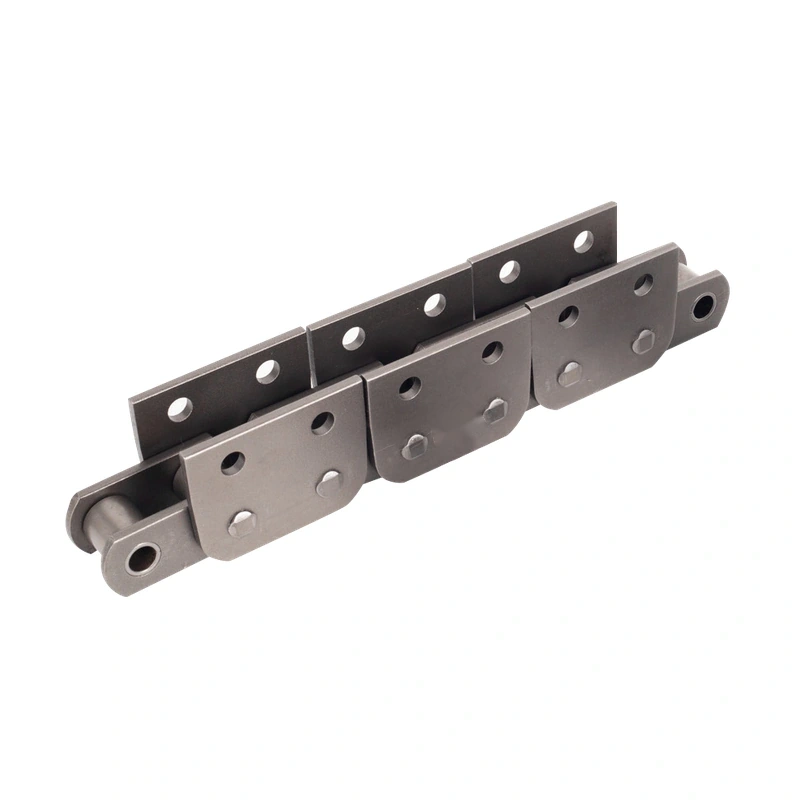
Two 42.0mm-pitch trenching chain variants with different rivet head forms. Compare attachment geometry, mounting holes and the complete EP model designation.
MOQ: flexible. Minimum order value USD 1,500; mixed orders and trial quantities available.
A trenching machine chain must keep its mounting features correctly positioned as it travels around the drive and boom. EP-CHK42 is a 42.0mm pitch family with two published rivet-head configurations: EP-CHKSC42C001 and EP-CHKRC42C001. Both are listed with the same major chain dimensions. Their distinction is in the square-head versus round-head rivet form, a detail that may influence access, retention practice or clearance in the installed assembly.
The 42.0mm pitch is the confirmed engineering value for both versions. The print reference contains a typographic error in one row; the corrected number is used throughout this product record. The buyer should still verify the complete chain against a drawing, because a pitch match and a rivet-head choice do not alone establish compatibility with a particular trencher boom, sprocket or cutting-tooth arrangement.
Pitch
42.0 mm
Hole d3
10.00 mm
Chain and plate geometry
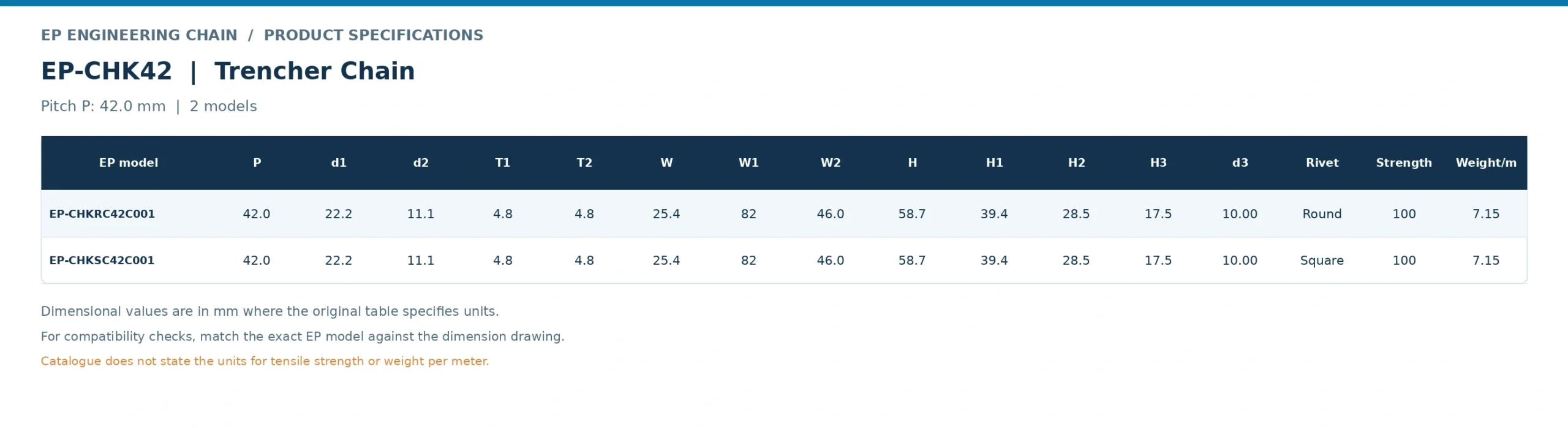
| EP Model | Pitch P (mm) | Roller d1 (mm) | Pin d2 (mm) | Plate T1 (mm) | Plate T2 (mm) | W (mm) | W1 (mm) | W2 (mm) |
|---|---|---|---|---|---|---|---|---|
| EP-CHKSC42C001 | 42.0 | 22.2 | 11.1 | 4.8 | 4.8 | 25.4 | 82 | 46.0 |
| EP-CHKRC42C001 | 42.0 | 22.2 | 11.1 | 4.8 | 4.8 | 25.4 | 82 | 46.0 |
Mounting and catalogue reference values
| EP Model | H (mm) | H1 (mm) | H2 (mm) | H3 (mm) | Hole d3 (mm) | Rivet head | Avg tensile* | Weight/m* |
|---|---|---|---|---|---|---|---|---|
| EP-CHKSC42C001 | 58.7 | 39.4 | 28.5 | 17.5 | 10.00 | Square | 100 | 7.15 |
| EP-CHKRC42C001 | 58.7 | 39.4 | 28.5 | 17.5 | 10.00 | Round | 100 | 7.15 |
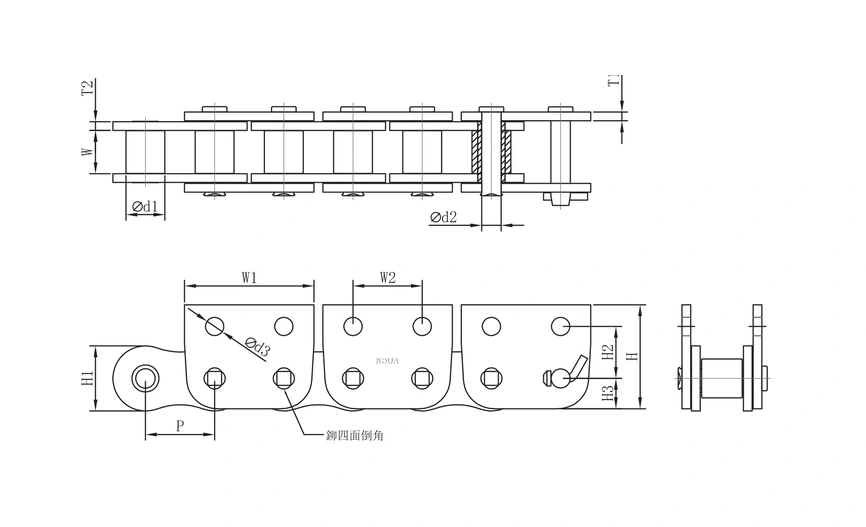
The corrected 42.0mm pitch applies to both rivet variants. The printed strength and weight numbers have no defined units in the available source.
For trenching machines that need other link arrangements, navigate the existing industrial chain range.
The EP-CHKSC42C001 designation identifies the square rivet-head form, while EP-CHKRC42C001 identifies the round rivet-head form. The published geometry in the specification table is otherwise the same for the two entries. Treat the head style as an explicit purchase parameter. Do not change it because another style is easier to obtain or appears to offer the same plate dimensions.
A field photograph taken from the outside of the chain may reveal the head style, but it should also include the opposite side and the attachment plate. Different head contours can matter where a guard, guide or neighboring component runs close to the chain. If the original manufacturer drawing specifies a head type, keep that requirement in the replacement review.
The 42mm chain uses a documented W dimension of 25.4mm, W1 of 82mm and W2 of 46.0mm. The vertical geometry includes H = 58.7mm, H1 = 39.4mm, H2 = 28.5mm and H3 = 17.5mm. The d3 hole is listed as 10.00mm. Those numbers define important positions that should be cross-referenced with the mounting component rather than described broadly as a standard attachment.
Before fitting a cutting accessory or bolt-on element, compare the hole diameter, center distances and the plate orientation shown on the drawing. Do not drill the attachment by copying a distorted or worn plate. A hole that has elongated in service can produce an apparently convenient measurement that differs from the original intended production value.
Rivet-head choice is part of the specification. Preserve the full model designation, and do not mistake a published tensile figure for an authorized field working load.
Both listed EP-CHK42 entries use d1 = 22.2mm and d2 = 11.1mm, with T1 and T2 both at 4.8mm. These are geometry figures, not laboratory evidence of fatigue life. The pin-and-roller pair needs to be consistent with the mating sprocket and the articulation required by the chain route.
The source includes an average tensile-strength figure of 100 and a weight-per-metre figure of 7.15, but it does not state their units. Those figures can be retained as catalogue comparison references; they must not be converted into a working-load promise or a kilogram-per-metre claim without written unit confirmation. Machine load evaluation requires service-specific information, not a single unqualified number.
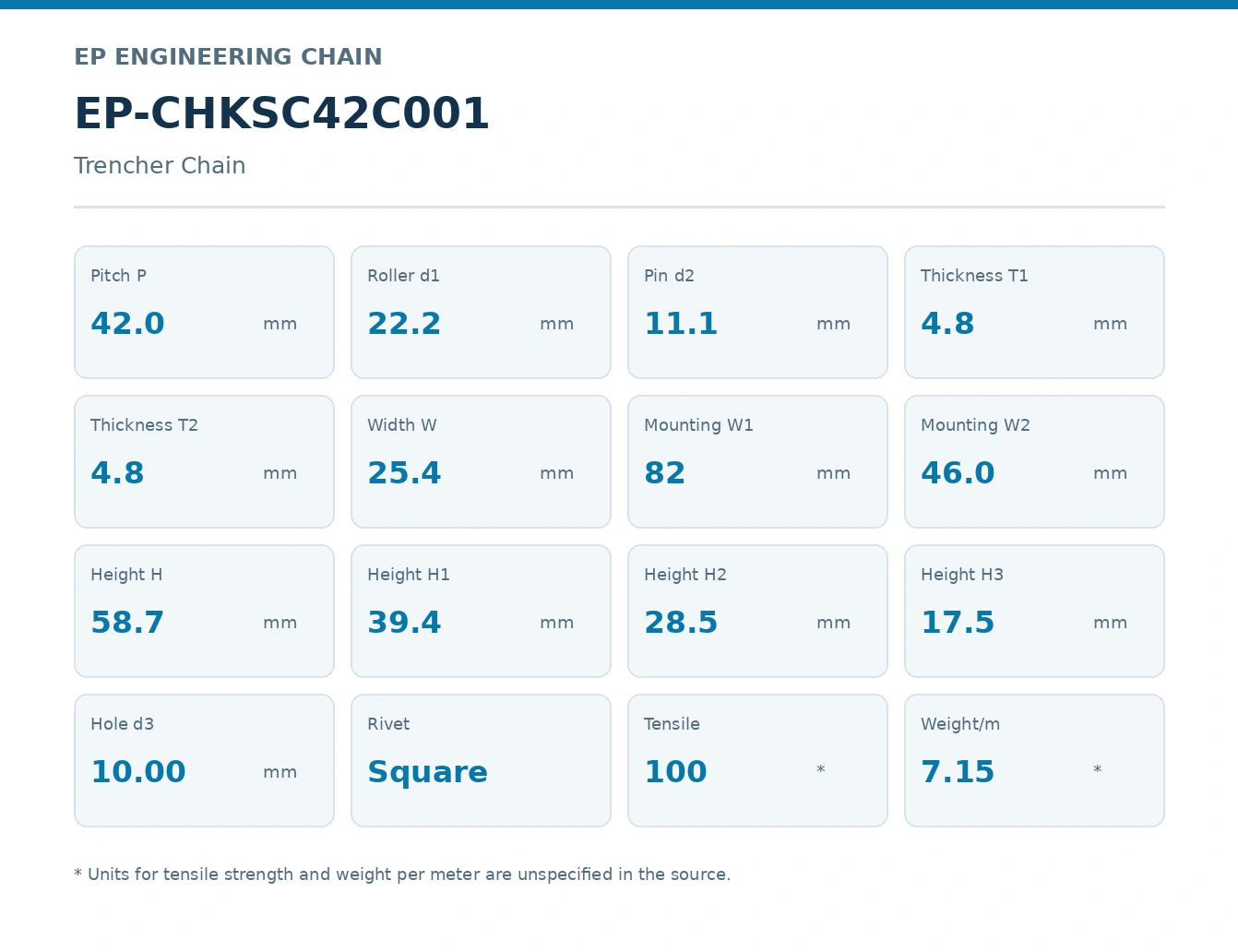
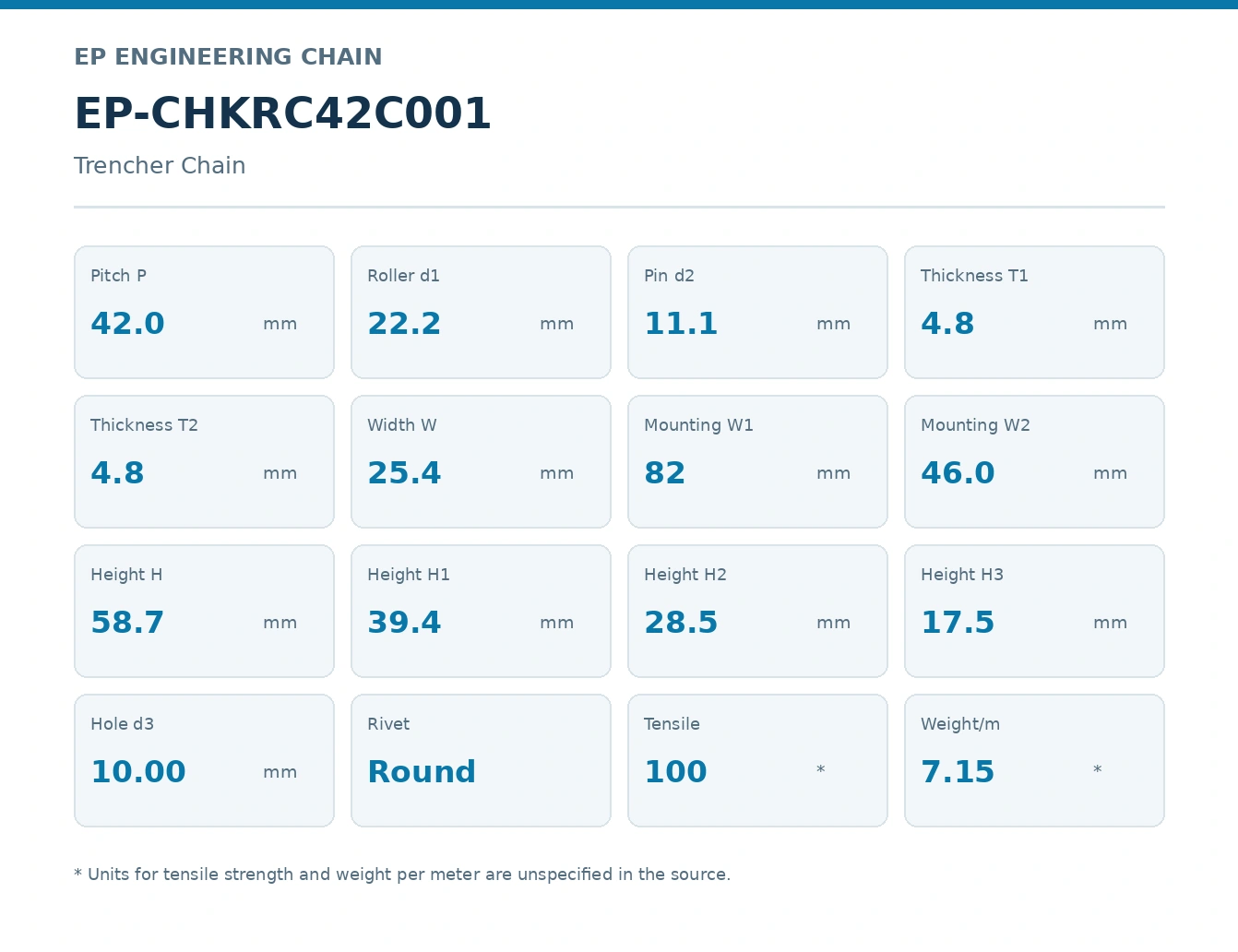
A trencher chain is only one part of a cutting system. The assembly can also include tooth holders, cutting teeth, sprockets, guides, connectors and fasteners. EP-CHK42 dimension data does not specify a complete tooth set or a named trenching machine installation. Buyers should therefore separate an enquiry for bare chain from an enquiry for a fully equipped cutting assembly.
Record the boom layout, required chain length and the intended arrangement of cutting elements. If a machine has been adapted to a different tooth pattern, provide a marked drawing showing the changed positions. This helps prevent the supplier from treating an installation-specific choice as a standard property of every 42mm chain.
To check articulation of the 42mm link around a boom drive, inspect relevant sprocket constructions; verify the tooth geometry and local mounting arrangement from the actual machine rather than assuming a catalogue match.
Mud, grit and impact-related debris may make small attachment and pin features difficult to inspect. Clean enough of the chain to observe side-plate straightness, pin-end condition and hole wear. Photograph damage together with a scale and mark whether it occurs repeatedly at the same position in the chain run.
After repair, check chain alignment and articulation under controlled operating conditions. Abnormal binding, contact against guards, loose hardware or irregular seating at the sprocket should prompt investigation before normal work resumes. The product record intentionally does not state a universal allowable working force or excavation performance figure because those data are not established by the supplied geometry.
Yes. The corrected pitch P is 42.0mm for EP-CHKSC42C001 and EP-CHKRC42C001. Both rows share the stated roller, pin and attachment dimensions; the listed rivet head type is different.
Match the form shown on the existing machine or its approved assembly drawing. Inspect nearby guides and access to the rivet end because a change of head profile should not be assumed harmless.
No. It is a published hole diameter in the chain attachment geometry. Cutting teeth, tooth holders, bolts and their pattern must be defined separately for the ordered assembly.
MOQ varies with the configuration and total value. A suitable new buyer may discuss 1-5 samples; 1-2 replacement pieces can involve a higher unit price. Mixed chain models are possible, normally with an approximate USD 1,500 minimum order value.
Use the quoted scope to determine timing: 10-25 business days for standard parts, 20-45 for custom components and 45-120 for project equipment are indicative. EXW, FOB, CIF and DAP are normal trade discussions; FCA, CFR, CPT, CIP and DDP need individual agreement.
State square or round rivet-head choice and show the 10mm mounting hole, along with the boom details. Ever Power can review the 42.0mm chain requirement before a trial or assembly order.
Request A 42mm Trencher Chain Fit Review
Audible noise is evidence to investigate, but fault location depends on whether the sound tracks speed, torque or the machine structure.
Flexible couplings accommodate limited relative movement, but poor shaft alignment still affects bearings and seals.
Oil observed on a housing may have traveled from a vent, joint or shaft seal; finding the first wet point is essential.