


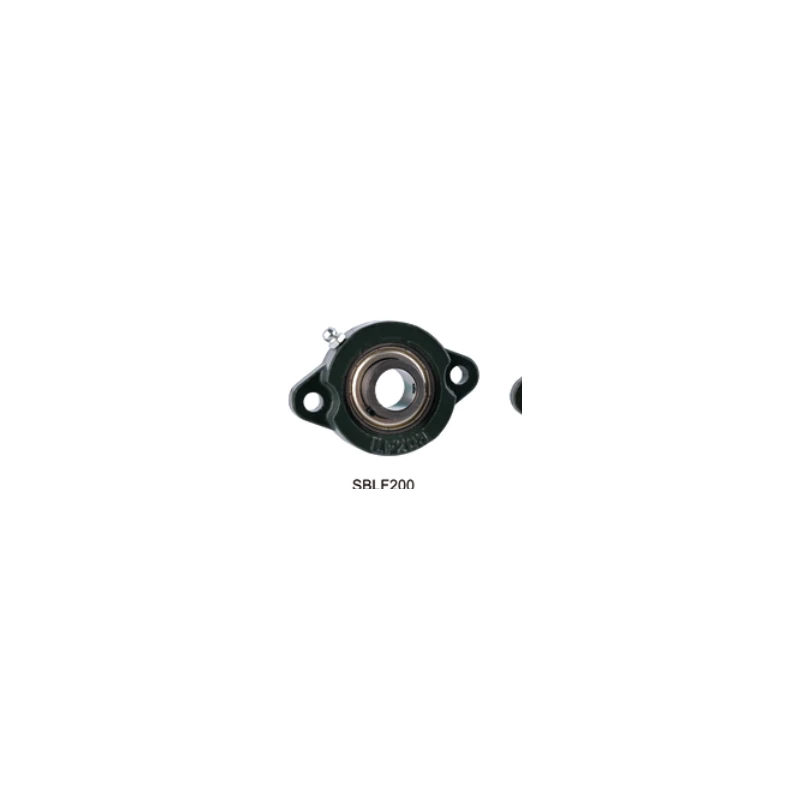
SBLF/SALF 2-Bolt Flange Bearing Units
SBLF/SALF is a standard duty series configured around 2-bolt flange bearing units. Its catalogue definition uses setscrew / eccentric locking, with individual bore and dimensional variants retained in one model table.
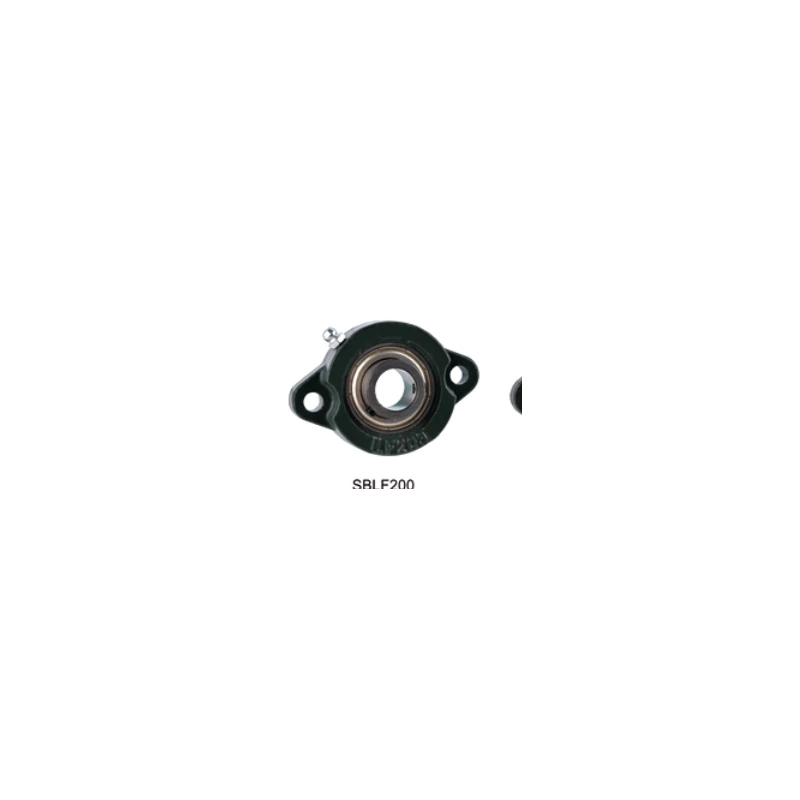
Series Overview
This product page groups the complete catalogue series under one title. Engineers can compare the available unit numbers inside the dimensional reference instead of moving between many nearly identical SKU pages.
Series selection works best from the machine interface outward: mounting face, shaft, locking method and finally the exact catalogue line. Related bearing families can be compared from the main bearing index. Browse related bearing families.
Series-Level Selection
SBLF/SALF is treated as one catalogue series, with individual unit numbers retained inside the dimensional table.
Mounting Form
The primary configuration is 2-bolt flange bearing units, intended for compact face mounting with a two-bolt flange footprint.
Locking Logic
The catalogue identifies setscrew / eccentric locking for this series; confirm the exact row before ordering.
Technical Specifications
Series attributes are separated from model dimensions here. This makes the page easier to scan while keeping the original line-by-line dimensional reference intact below.
| Series | SBLF/SALF |
|---|---|
| Catalogue Reference | Part B, page B38 |
| Product Family | 2-Bolt Flange Bearing Units |
| Duty Classification | Standard duty |
| Locking / Mounting Method | Setscrew / eccentric locking |
| Inner Ring / Bore Form | Wider inner ring / series-specific bore |
| Housing / Configuration | 2-Bolt Flange Bearing Units |
| Material Note | Material varies by unit; confirm selected model |
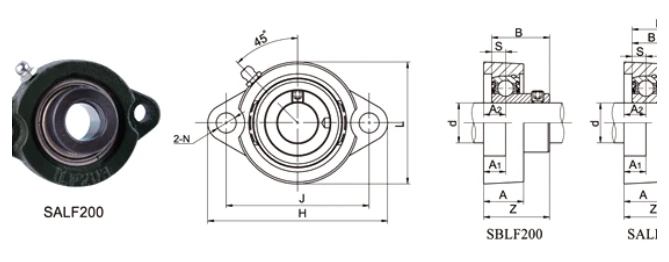
Engineering Drawing
For replacement work, compare the drawing with the installed housing rather than relying on a familiar series code alone. Mounting dimensions and locking details are the better confirmation points.

Applications
Conveyors and small handling systems
SBLF/SALF is relevant when conveyors and small handling systems requires this housing format; verify shaft geometry, mounting interface, operating conditions and environment before final selection.
Packaging machinery
For packaging machinery, this series provides the catalogue mounting form shown above. Confirm load, speed, shaft dimensions and service environment for the chosen model.
General industrial frames
SBLF/SALF is relevant when general industrial frames requires this housing format; verify shaft geometry, mounting interface, operating conditions and environment before final selection.
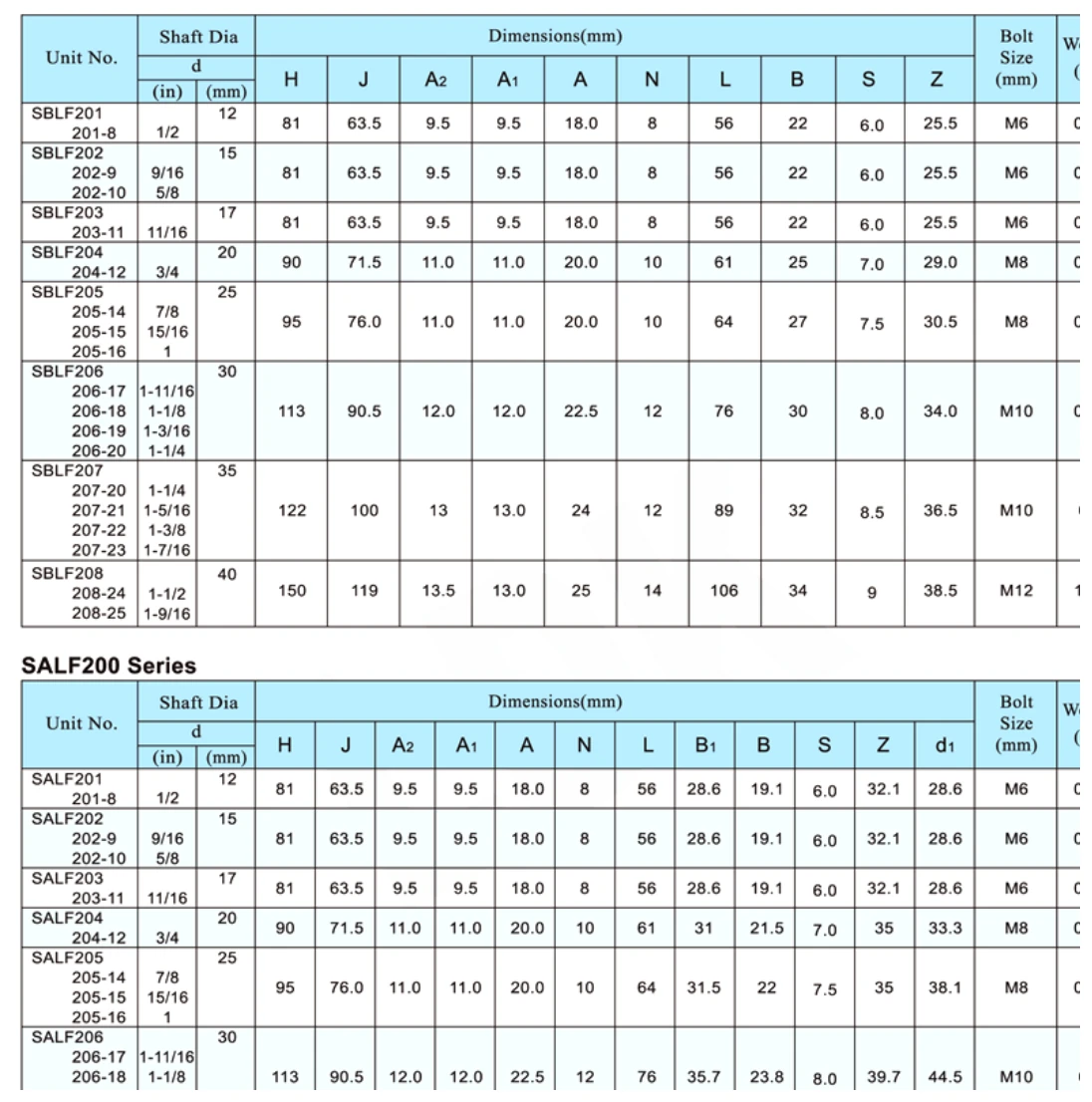
Catalogue Dimensional Data
The dimensional data is retained as one complete source table. This is especially useful when adjacent sizes share a housing but differ in shaft, inner-ring or mounting dimensions.
Selection & Integration
Where several series share a similar housing silhouette, the deciding details are usually locking method, duty class and one or two mounting dimensions. Verify those before comparing the remaining model rows. In this family, the intended role is compact face mounting with a two-bolt flange footprint.
| Step | Information To Confirm |
|---|---|
| 1 | shaft diameter |
| 2 | two-bolt spacing |
| 3 | housing orientation |
| 4 | locking method and shaft alignment |
The model code should be verified together with its dimensional row. This is particularly important where metric and inch variants share similar housings but differ at the shaft interface.
RFQ Support
Confirm The Exact SBLF/SALF Configuration
A useful RFQ includes the target model or shaft size, mounting dimensions, quantity and any environment requirement. That gives the quotation review enough information to confirm the catalogue row. Ever Power Netherlands Branch can review the quotation basis against the same reference.