


Overview
The unusual 66.27mm pitch is the defining characteristic of EP-CHG66A. A field measurement may tempt a mechanic to round that figure toward an adjacent nominal chain size, especially when the sample has wear or accumulated dirt. For a sprocket-driven conveyor, a small error repeated along many chain links can prevent correct seating even when one or two links appear to fit by eye. This product page therefore starts with pitch identification before discussing any purchase decision.
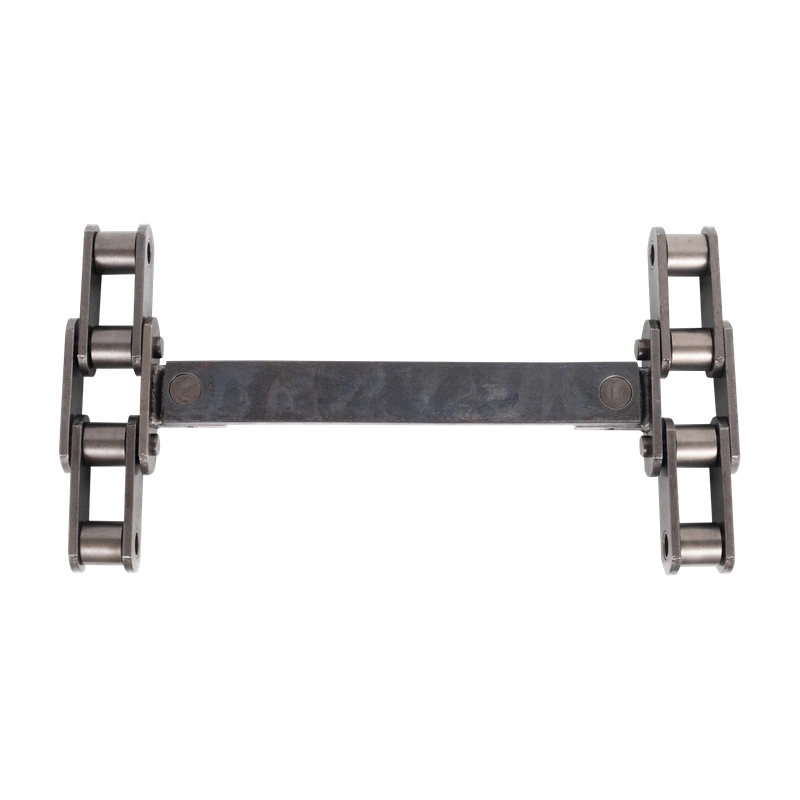
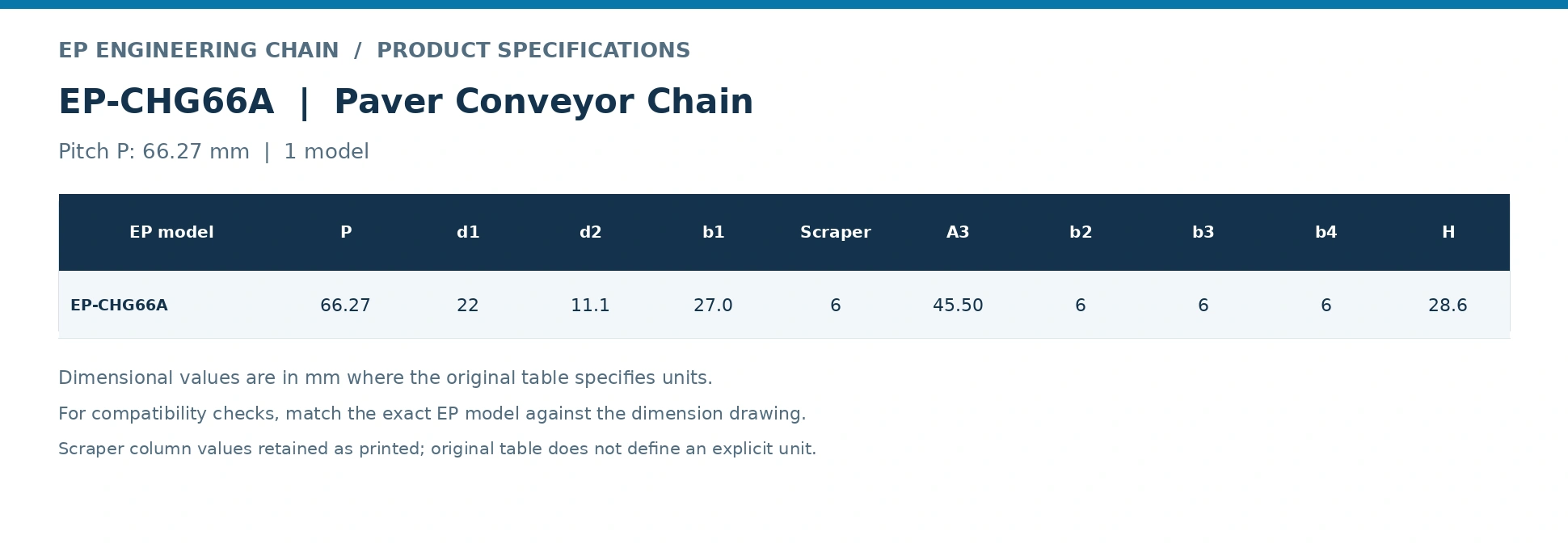
EP-CHG66A is a documented single configuration. The catalogue lists a 22mm roller diameter, 11.1mm pin diameter, 27.0mm inner-plate clearance and 45.50mm scraper offset A3. These numbers describe an assembly to be identified as a whole. They are not an invitation to replace it with a merely similar standard roller chain.
Pitch
66.27 mm
Scraper offset
45.50 mm
Full Technical Specifications
Complete model dimensions
| EP Model | Pitch P (mm) | Roller d1 (mm) | Pin d2 (mm) | Inner width b1 (mm) | Scraper* | Offset A3 (mm) | Inner plate b2 (mm) | Outer plate b3 (mm) | Outer plate b4 (mm) | Plate height H (mm) |
|---|---|---|---|---|---|---|---|---|---|---|
| EP-CHG66A | 66.27 | 22 | 11.1 | 27.0 | 6 | 45.50 | 6 | 6 | 6 | 28.6 |

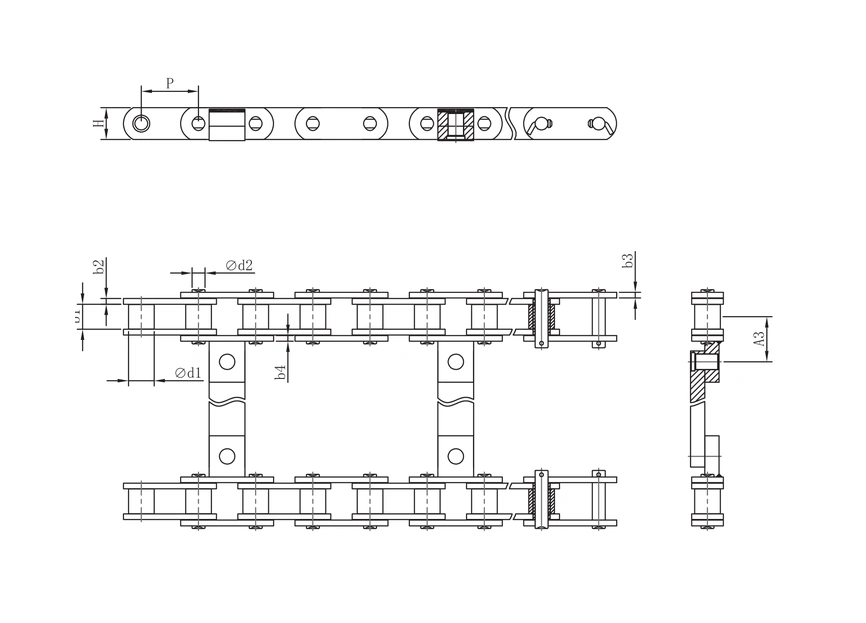
The printed Scraper entry is 6; the source does not define it sufficiently to generate a finished attachment interval without drawing approval.

Related Chain Selection
When the original pitch seems unusual, survey the available industrial chain range.
Measure Across Several Links
A single center-to-center measurement can be distorted by wear, pin motion or inaccurate access. Lay a clean length of chain straight and measure the same reference points over multiple pitches. Divide the total center-to-center distance by the number of intervals, taking care not to count the number of pins as the number of intervals. Photograph the setup so an engineer can assess whether the measurement is reliable.
When the result is close to 66.27mm, compare it with the sprocket and the recorded chain code. Do not adjust the drawing to match a convenient commercial size. If the chain is elongated unevenly, use an unrun sample, an OEM dimension drawing or a carefully verified sprocket pitch circle as additional evidence. The objective is to recover the original intended geometry rather than to reproduce the wear of the removed chain.
Roller Engagement Geometry
A 22mm roller should be checked against the tooth pocket that receives it. The 11.1mm pin and 27.0mm between-plate width require separate confirmation. Correct pitch alone does not establish whether the roller can move freely through the sprocket and adjacent support members. Gauge the space with the chain fully articulated instead of assuming that static dimensions represent the entire running envelope.
Repeated polygonal engagement at the drive sprocket can expose pitch mismatch through tight spots, climbing or irregular noise. Such symptoms can also have other causes, so the responsible method is to inspect alignment, tooth condition and chain tension together. A replacement should not be approved solely because its pitch looks close on a handheld caliper.
A nearly matching pitch is not a verified mechanical fit. Confirm the accumulated pin spacing and the tooth pocket before switching a chain specification.
Scraper Alignment Checks
The drawing assigns EP-CHG66A an A3 value of 45.50mm and a plate height H of 28.6mm. The indicated b2, b3 and b4 dimensions are all 6mm. These values form a compact reference for an attachment that must clear the machine structure over the full transport route. Compare its projected position with the existing scraper hardware and guide rails.
Photographs taken from directly above and perpendicular to the side of the installed chain are more useful than an oblique general machine picture. Include at least one view of the attachment fastening point and its relationship to the adjacent chain plates. If mounting holes or spacers are modified, supply a drawing that shows the change; an unrecorded workshop adaptation can make an otherwise correct replacement appear unsuitable.
Controlled Substitution Decision
Some buyers reach this model after searching for a 65mm or 66mm chain. A responsible comparison should separate numerical proximity from interchangeability. Start with pin-center geometry and available sprocket tooth data, then check roller diameter, inner width, scraper offset and plate height. Document any deviation before a new part is manufactured or installed.
Where a different pitch is under consideration, evaluating only one section of the conveyor is not enough. Engagement errors can accumulate along the drive, idlers and return path. The replacement project should consider the complete chain path, not a short link held against the old one.
A suspected pitch mismatch should lead to a separate review of sprocket constructions; verify the tooth geometry and local mounting arrangement from the actual machine rather than assuming a catalogue match.
Commissioning Observations
For a repaired conveyor, rotate the assembly slowly without material to watch for abnormal seating and unexpected interference. Check both the drive and the return before increasing operating duty. Stop if a scraper contacts fixed metal, if a link binds or if a roller does not seat consistently in its tooth pocket.
After an initial run, inspect fasteners, chain alignment and lubrication conditions according to the machine service requirements. No universal tension or permissible wear number is claimed for this specific configuration because those limits are not provided in the source drawing. They should be confirmed from machine documentation or a project-specific engineering decision.

Measurement And RFQ Sequence
- Clean a section long enough to measure more than one link interval without side loading the chain.
- Measure multiple pin-center intervals and compute an average; record the raw distance and number of intervals.
- Check the same chain against the 22mm roller and 11.1mm pin entries.
- Compare the scraper A3 of 45.50mm and the plate height of 28.6mm with the fitted conveyor.
- Send a photo of the drive sprocket and a marked measurement drawing to support the match assessment.
Inspection Priorities
- Investigate any attempt to round 66.27mm to a neighboring nominal pitch.
- Inspect rollers that sit high in the sprocket pockets or alternate between free and tight rotation.
- Observe alignment through the return path where attachment interference may be less visible.
- Verify that every reported measurement refers to the same chain, not a mixture of old and replacement samples.
Frequently Asked Questions
May 66.27mm pitch be rounded to 65mm for an enquiry?
No. EP-CHG66A is listed at 66.27mm. Provide the actual measured value and its measurement method; the supplier should not redefine the intended pitch merely to match a more common nominal size.
What is the quickest way to prove the pitch on a stretched sample?
Measure a straight run across several successive pin intervals, record the entire span, and divide by the interval count. Compare that calculation with a drawing or sound spare link if the old chain shows significant elongation.
Does the listed 22mm roller establish sprocket compatibility?
It is one necessary check, not sufficient proof. The tooth geometry, chain pitch, roller seating, shaft alignment, attachment clearance and plate width should also be reviewed before replacement.
Are trial or mixed orders considered for a special-pitch chain?
Quantity can be flexible where the configuration is appropriate. A first-time buyer may discuss 1-5 sample pieces, and 1-2 pieces may carry a higher unit price. Different chain models can be combined toward the approximate USD 1,500 minimum order value.
How should I plan delivery and shipping terms?
For planning, use 10-25 working days for standard items, 20-45 for custom components and 45-120 for larger project equipment, subject to final quotation. EXW/FOB/CIF/DAP are usual options; FCA/CFR/CPT/CIP/DDP can be negotiated for a suitable shipment.
Discuss Your Chain Project
Share the measured number of intervals, total span and sprocket evidence when asking Ever Power to review the unusual 66.27mm pitch. An evidence-backed pitch record helps prevent a costly near-size error.
Send A 66.27mm Pitch Verification Enquiry