


Overview
A 65mm pitch is only the start of identifying a replacement chain for the material conveyor in an asphalt paver. The EP-CHG65 range contains two documented choices, EP-CHG65A and EP-CHG65B. They share the nominal center-to-center pitch and the published plate height, yet their internal space, roller size and scraper geometry differ substantially. This page is intended for engineers who have an old chain on a bench and need to avoid ordering the wrong assembly.
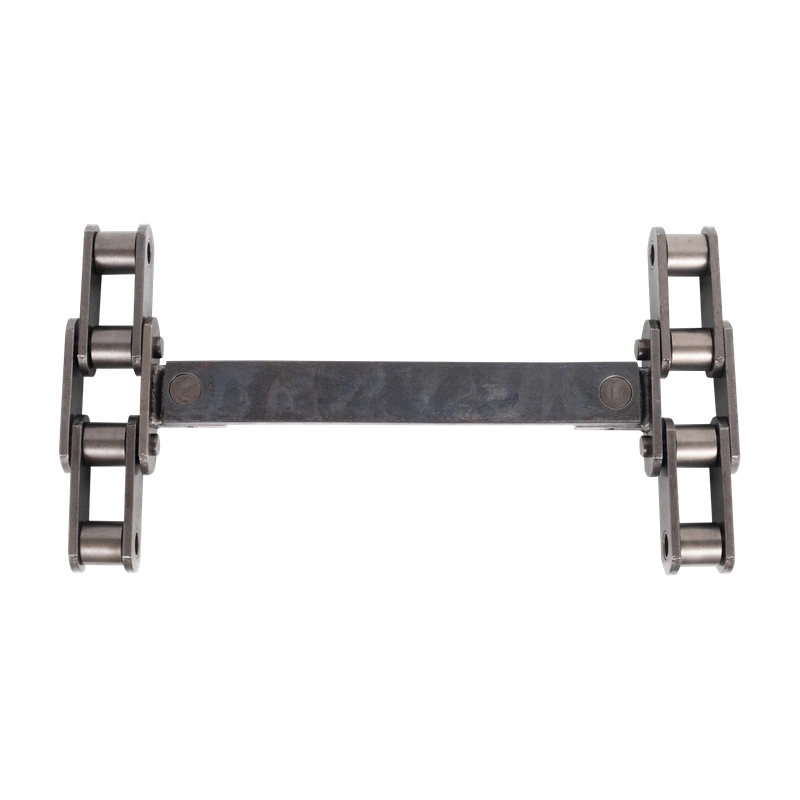
The selection decision is usually made at the machine, not from a generic chain chart. A chain that engages the sprocket can still foul a guide, place a crossbar outside its intended track or misalign the scraper hardware. Begin with the complete geometry of the installed chain, record the worn condition separately and compare both EP-CHG65 options before requesting production or replacement stock.
Pitch
65 mm
Largest b1
40.0 mm
Full Technical Specifications
Complete model dimensions
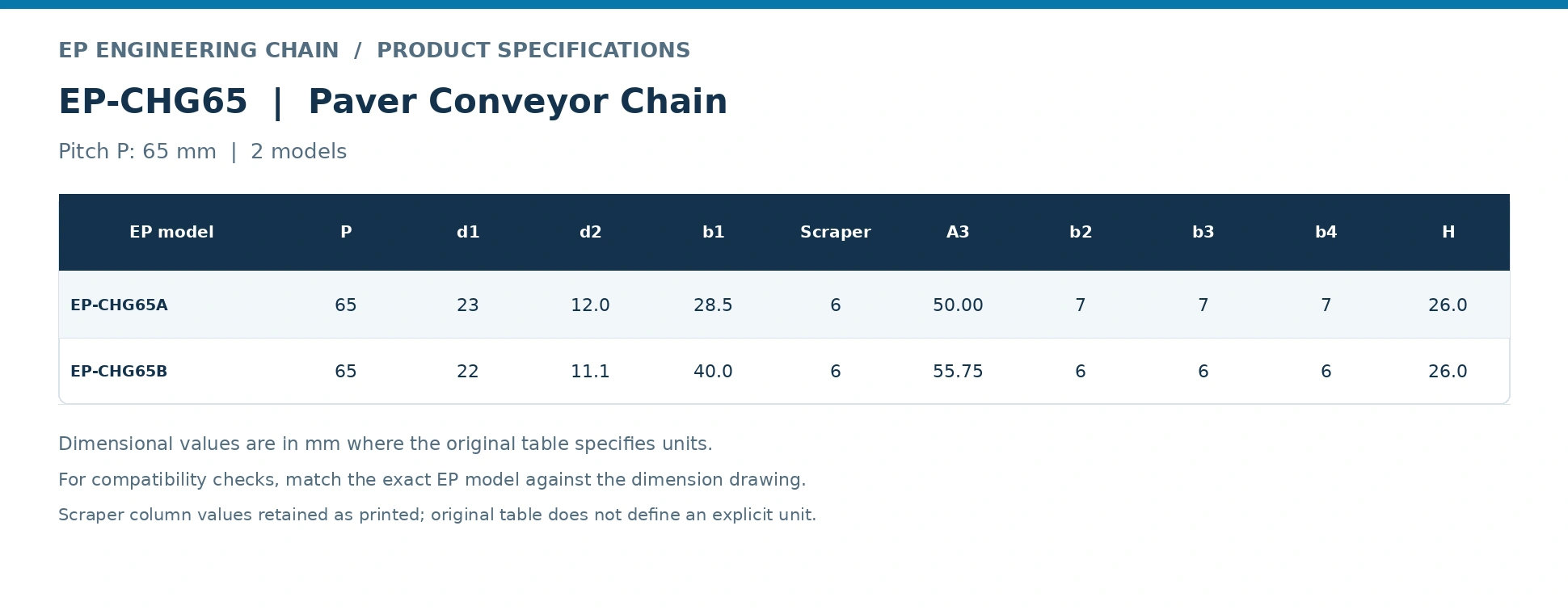
| EP Model | Pitch P (mm) | Roller d1 (mm) | Pin d2 (mm) | Inner width b1 (mm) | Scraper* | Offset A3 (mm) | Inner plate b2 (mm) | Outer plate b3 (mm) | Outer plate b4 (mm) | Plate height H (mm) |
|---|---|---|---|---|---|---|---|---|---|---|
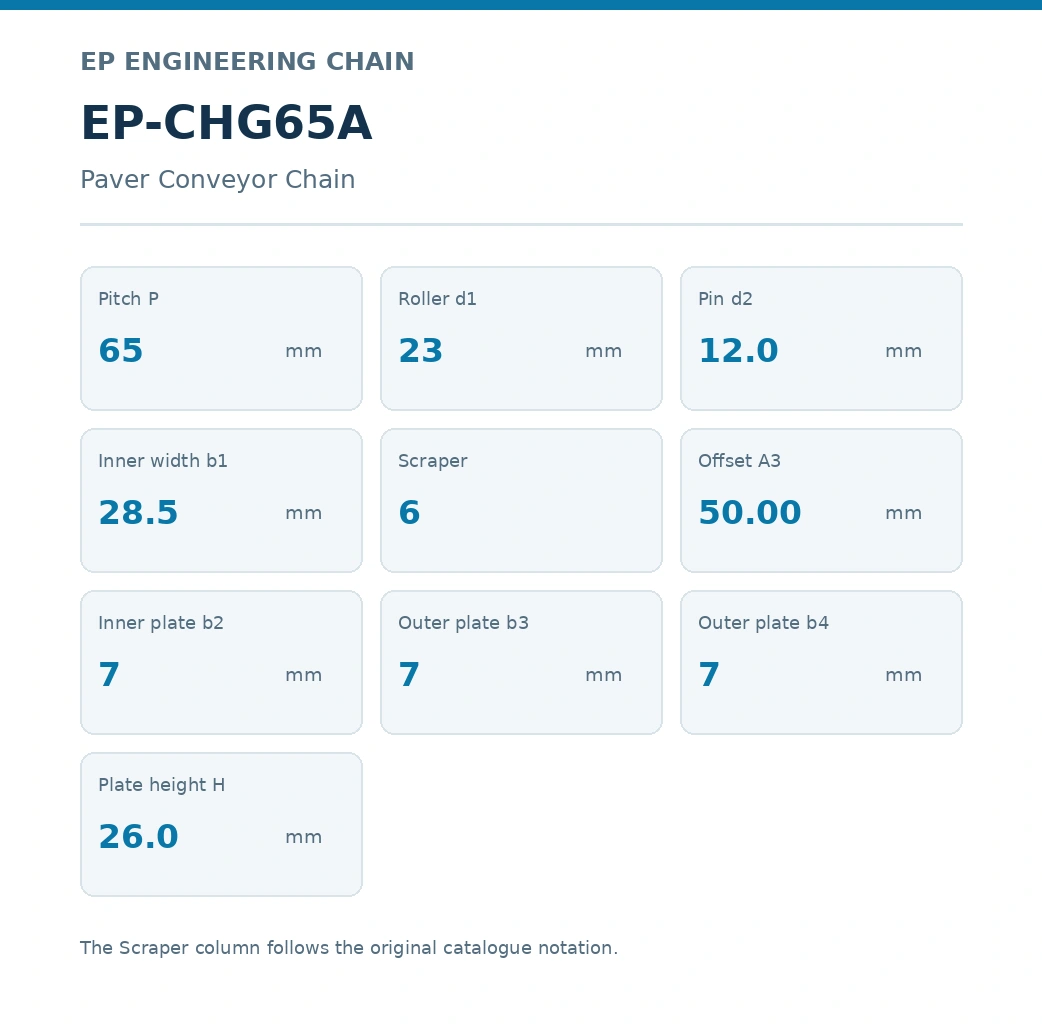
| EP-CHG65A | 65 | 23 | 12.0 | 28.5 | 6 | 50.00 | 7 | 7 | 7 | 26.0 |
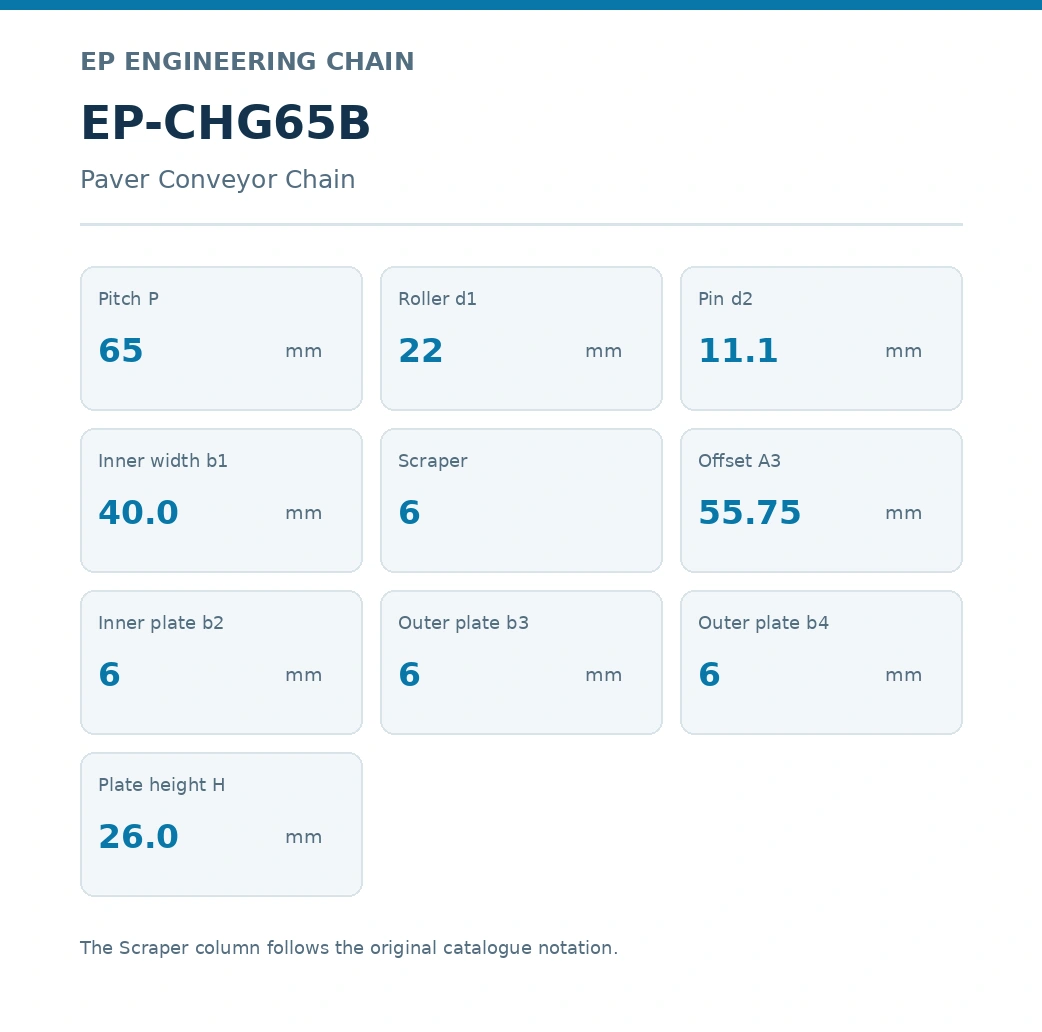
| EP-CHG65B | 65 | 22 | 11.1 | 40.0 | 6 | 55.75 | 6 | 6 | 6 | 26.0 |

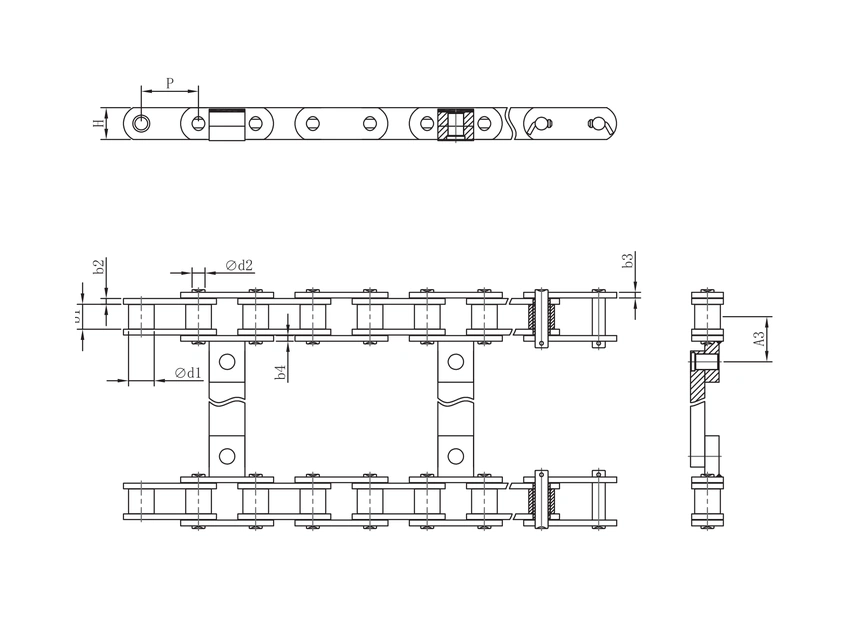
The Scraper source column contains values rather than a confirmed unit of distance. Attachment count or spacing must be specified in the ordered assembly drawing.

Related Chain Selection
To compare a different chain construction with these two 65mm assemblies, examine the broader industrial chain range.
Where The Width Matters
The clearest split between these models is the clearance between the inner plates: 28.5mm for EP-CHG65A and 40.0mm for EP-CHG65B. That 11.5mm difference affects the lateral envelope occupied by the roller assembly and the relation between the chain and its supporting path. Inspect nearby stationary metalwork, guide surfaces and attachment spacers. Measure the existing chain where the plates are not bent or heavily worn, then compare the result with the machine drawing if available.
The published roller and pin pairs reinforce the identification: 23mm and 12.0mm on A; 22mm and 11.1mm on B. Do not assume that a larger inner width automatically means a larger roller or stronger construction. Here the numbers move in different directions. For procurement, retaining a single measurement such as pitch while discarding the others can conceal a meaningful mismatch.
Scraper Position Review
An asphalt paver conveyor carries its material-handling attachments along a constrained route. The scraper offset A3 is stated as 50.00mm for the A model and 55.75mm for the B model. This is not a cosmetic difference. Before selecting hardware, check how the scraper sits relative to the chain centerline, its neighboring conveyor components and the available running clearance throughout the loaded and return paths.
Both versions have the published plate height H of 26.0mm. Their b2, b3 and b4 figures also follow different patterns, each 7mm for A and 6mm for B. These dimensions should be read with the dimension drawing; they must not be collapsed into a vague statement that both models have the same plate style. The catalogue Scraper entry is 6 for each and is retained as a source field rather than presented as an unverified dimension in millimeters.
Decision rule: compare b1 and A3 together. Two chains with the same pitch can still occupy different conveyor envelopes.
The Twin-Run Question
Many scraper conveyor layouts use a pair of chains that move attachments through the machine. When checking a twin-run arrangement, measure the distance between chains and compare the attachment fixing geometry on both sides. Matching individual chain dimensions without checking the connecting hardware can lead to a set that looks acceptable loose but cannot be installed as a complete assembly.
Inspect whether one run has been replaced before, whether the attachment spacing is identical left and right, and whether the drive and idler sprockets are of the same wear condition. A replacement enquiry should indicate if the required supply is one run, a matched pair or a preassembled length including crossbars. None of these supply configurations should be inferred from the EP-CHG65 series name alone.

Inspection Before Ordering
Start the bench inspection by cleaning a few links and looking for an undamaged roller and pin end. Verify that the plate edges have not been spread by a jam and that the holes have not become visibly elongated. A badly stretched or damaged sample is useful for identification, but its dimensions should be interpreted alongside a new-part drawing wherever possible.
A common repair trap is to replace only the chain while leaving a hooked or unevenly worn sprocket in place. Check the sprocket tooth pockets, keying and alignment, then compare the intended chain engagement. For a wider view of related transmission components, the established sprocket selection on the site can be used as a starting point; final tooth geometry still needs engineering approval.
The guide and sprocket survey may reveal unequal wear on paired chains. Inspect sprocket constructions; verify the tooth geometry and local mounting arrangement from the actual machine rather than assuming a catalogue match.
A Practical Selection Record
A useful replacement record fits on one page: original model marking, 65mm nominal pitch, measured roller and pin sizes, between-plate clearance, offset A3, H dimension, required length and number of attachments. Add two photographs showing the old chain beside a scale and one image showing the installed conveyor path. These items reduce the back-and-forth normally caused by an enquiry containing only a machine description.
If the old part is so worn that the A/B distinction remains unclear, ask for a marked-up drawing rather than forcing a choice. Ever Power can review the dimensions supplied by the buyer and determine whether the published configuration matches or whether the case needs a project-specific drawing. A model is not treated as interchangeable until the critical dimensions are checked.
Measurement And RFQ Sequence
- Establish that the chain has a nominal pin-center pitch of 65mm by measuring several consecutive links.
- Record the clear width between undamaged inner plates; it is the fastest distinction between the A and B variants.
- Measure one sound roller and pin, and compare the results with the exact model row rather than a general chart.
- Transfer the scraper offset and b2/b3/b4 measurements from the engineering drawing to a matching checklist.
- Confirm chain length, attachment pattern, paired-run requirement and sprocket fit before approving the order.
Inspection Priorities
- Check for scoring on the roller surface that could change the apparent running diameter.
- Look for bent scraper supports that could make the measured A3 value misleading.
- Inspect left and right chains for different stretch and uneven tension.
- Compare the installed chain with the conveyor guide and discharge clearance, not just a loose sample.
Frequently Asked Questions
Is EP-CHG65A an automatic replacement for EP-CHG65B?
No. Although the stated pitch is 65mm for both, their inner widths are 28.5mm and 40.0mm, and the roller, pin and A3 dimensions also differ. Confirm those measurements and the attachment arrangement before any substitution.
Why measure the inner plates instead of the outside of the chain?
External width can be affected by rivet heads or fitted hardware. The published b1 value is explicitly the width between the inner plates, so take that measurement directly at an undamaged location and compare the result with the correct table column.
What photographs help identify a worn paver conveyor chain?
Provide a close image of the roller and pin, one showing the scraper connection, one transverse view revealing the clear plate width, and an installed view showing the sprocket path. Include a ruler or scale in at least one view.
Can I order one or two replacement pieces before a full set?
Small quantities of 1-2 pieces can be considered at a higher unit cost. Where suitable, new customers may request 1-5 samples. MOQ is flexible by product and total order value; mixed-model enquiries are welcome, with an approximate USD 1,500 minimum order value.
What delivery and trade terms apply to EP-CHG65 orders?
Indicative lead times are 10-25 working days for standard parts, 20-45 for custom components, and 45-120 for project-type equipment. EXW, FOB, CIF and DAP are commonly supported; FCA, CFR, CPT, CIP and DDP may be discussed case by case. Final timing depends on the confirmed configuration.
Discuss Your Chain Project
Send your 65mm A/B width and A3 findings with the existing conveyor photos. The Ever Power team can discuss which of the two listed constructions corresponds to your repair requirement.
Check My EP-CHG65 Chain Dimensions